Engineering Graphenes from the Nano- to the Macroscale for Electrochemical Energy Storage

Expand
  • 1 Nanoyang Group, School of Chemical Engineering and Technology, Collaborative Innovation Center of Chemical Science and Engineering(Tianjin), Tianjin University, Tianjin 300072, China;
    2 School of Marine Science and Technology, Tianjin University, Tianjin 300072, China;
    3 Engineering Laboratory for Functionalized Carbon Materials, Shenzhen Key Laboratory for Graphene-based Materials, Graduate School at Shenzhen, Tsinghua University, Shenzhen 518055, China;
    4 Division of Fuel Cell and Battery, Dalian National Laboratory for Clean Energy, Dalian Institute of Chemical Physics, Chinese Academy of Sciences, Dalian 116023, China

Received date: 2018-02-14

  Revised date: 2018-03-27

  Online published: 2018-04-26

Supported by

This work was supported by the National Natural Science Foundation of China (Nos. U1710109, 51772164, 51525204 and 21506212), Guangdong Natural Science Funds for Distinguished Young Scholar (No. 2017B030306006) and Shenzhen Basic Research Projects (Nos. JCYJ20150529164918734, JCYJ20170412171630020 and JCYJ20170412171359175).
Abstract

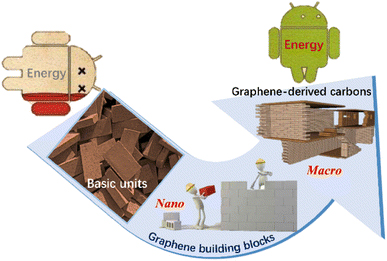
Carbon is a key component in current electrochemical energy storage (EES) devices and plays a crucial role in the improvement in energy and power densities for the future EES devices. As the simplest carbon and the basic unit of all sp2 carbons, graphene is widely used in EES devices because of its fascinating and outstanding physicochemical properties; however, when assembled in the macroscale, graphene-derived materials do not demonstrate their excellence as individual sheets mostly because of unavoidable stacking. This review proposal shows to engineer graphene nanosheets from the nano- to the macroscale in a well-designed and controllable way and discusses how the performance of the graphene-derived carbons depends on the individual graphene sheets, nanostructures, and macrotextures. Graphene-derived carbons in EES applications are comprehensively reviewed with three representative devices, supercapacitors, lithium-ion batteries, and lithium-sulfur batteries. The review concludes with a comment on the opportunities and challenges for graphene-derived carbons in the rapidly growing EES research area.

Full-text:https://link.springer.com/article/10.1007/s41918-018-0006-z

Cite this article

Junwei Han, Wei Wei, Chen Zhang, Ying Tao, Wei Lv, Guowei Ling, Feiyu Kang, Quan-Hong Yang . Engineering Graphenes from the Nano- to the Macroscale for Electrochemical Energy Storage[J]. Electrochemical Energy Reviews, 2018 , 1(2) : 139 -168 . DOI: 10.1007/s41918-018-0006-z

Options
Outlines

/