Electrode Materials for Sodium-Ion Batteries: Considerations on Crystal Structures and Sodium Storage Mechanisms

Expand
  • 1 Centre for Clean Energy Technology, Faculty of Science, University of Technology Sydney, Ultimo, NSW 2007, Australia;
    2 CIC EnergiGUNE, Parque Tecnológico de Álava, 48, 01510 Miñano, Álava, Spain

Received date: 2018-03-08

  Revised date: 2018-04-24

  Online published: 2018-06-06

Supported by

This original research was supported by the Australia Research Council and University of Technology Sydney (UTS), through the Discovery Early Career Researcher Award (DECRA DE170101009), ARC Discovery Project (DP170100436) and Australian Renewable Energy Agency (ARENA) 2014/RND106.
Abstract

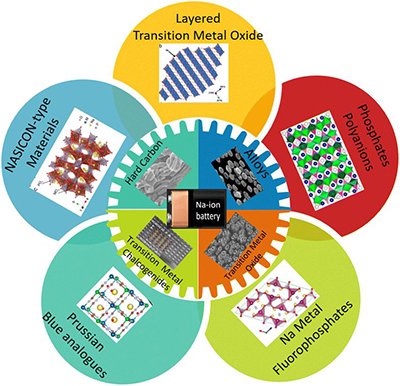
Sodium-ion batteries have been emerging as attractive technologies for large-scale electrical energy storage and conversion, owing to the natural abundance and low cost of sodium resources. However, the development of sodium-ion batteries faces tremendous challenges, which is mainly due to the difculty to identify appropriate cathode materials and anode materials. In this review, the research progresses on cathode and anode materials for sodium-ion batteries are comprehensively reviewed. We focus on the structural considerations for cathode materials and sodium storage mechanisms for anode materials. With the worldwide efort, high-performance sodium-ion batteries will be fully developed for practical applications.

Full-text:https://link.springer.com/article/10.1007/s41918-018-0009-9

Cite this article

Tianyi Wang, Dawei Su, Devaraj Shanmukaraj, Teoflo Rojo, Michel Armand, Guoxiu Wang . Electrode Materials for Sodium-Ion Batteries: Considerations on Crystal Structures and Sodium Storage Mechanisms[J]. Electrochemical Energy Reviews, 2018 , 1(2) : 200 -237 . DOI: 10.1007/s41918-018-0009-9

Options
Outlines

/