Electrochemical Energy Reviews >
Electrode Materials for Rechargeable Zinc-Ion and Zinc-Air Batteries: Current Status and Future Perspectives
Received date: 2019-01-16
Revised date: 2019-02-13
Online published: 2019-09-18
Supported by
The authors gratefully acknowledge the National Key R&D Program of China (Grant No. 2018YFB0905400), the National Natural Science Foundation of China (Grant No. 51622210, 51872277, 21606003 and 51802044), the DNL Cooperation Fund, CAS (DNL180310), the Fundamental Research Funds for Central Universities (WK3430000004) and the Opening Project of CAS Key Laboratory of Materials for Energy Conversion.
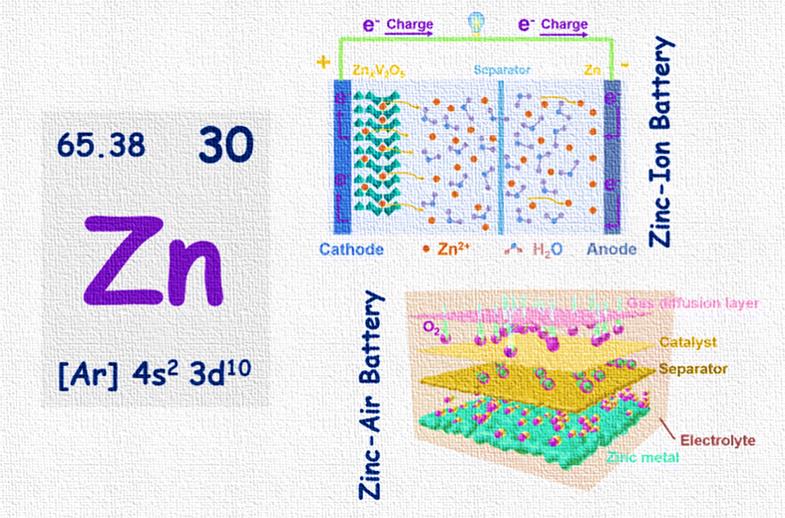
Advanced energy storage systems hold critical signifcance in satisfying the ever-increasing global demand for energy. And as a viable and efective alternative to lithium-ion batteries that dominate the current energy market, Zn-based batteries[i.e. Zn-ion batteries (ZIBs) and Zn-air batteries (ZABs)] have attracted extensive research eforts. Zn metal possesses many advantages because of its high theoretical capacity, its inexpensiveness and its good safety characteristic, and in recent years, tremendous eforts have been carried out to accelerate the development of ZIBs and ZABs with various electrode materials and electrocatalysts being proposed and investigated. In addition, with advances in characterization techniques, the underlying reaction mechanisms of these materials are also being elucidated. Therefore, this review will provide a comprehensive summary of the latest progress in various electrode materials adopted in the current ZIBs and ZABs along with corresponding mechanisms. Specifcally, Mn- and V-containing cathode materials for ZIBs and associated reaction mechanisms will be thoroughly discussed, and emerging cathodes such as Prussian blue analogues, NASICON-type nanostructures and organic compounds will be presented. In terms of ZABs, this review will discuss three major types of electrocatalysts, including noble metals, heteroatom-doped carbons and transition metal oxides/sulphides/phosphides/nitrides. In addition, as a critical factor in the performance of Zn-based batteries, challenges encountered by the current Zn anodes and strategies developed to tackle these issues will be discussed as well. Finally, a short summary including the current progress and future perspectives of ZIBs and ZABs will be provided.
Full-text:https://link.springer.com/article/10.1007/s41918-019-00035-5/fulltext.html
Key words: Zn-ion battery; Zn-air battery; Cathode material; Electrocatalyst; Zn anode
Dan Yang, Huiteng Tan, Xianhong Rui, Yan Yu . Electrode Materials for Rechargeable Zinc-Ion and Zinc-Air Batteries: Current Status and Future Perspectives[J]. Electrochemical Energy Reviews, 2019 , 2(3) : 395 -427 . DOI: 10.1007/s41918-019-00035-5
/
| 〈 |
|
〉 |