Electrochemical Energy Reviews >
In Situ Transmission Electron Microscopy Studies of Electrochemical Reaction Mechanisms in Rechargeable Batteries
Received date: 2018-10-19
Revised date: 2019-03-20
Online published: 2019-09-18
Supported by
This work was supported by the Assistant Secretary for Energy Efciency and Renewable Energy, Ofce of Vehicle Technologies of the U.S. Department of Energy under Contract No. DE-AC02-05CH11231, Subcontract No. 18769 and No. 6951379 under the Advanced Battery Materials Research (BMR) program. This work was supported by U.S. DOE (Department of Energy) EERE (Energy Efciency and Renewable Energy) BETO (Bioenergy Technology Ofce) (grant No. DE-EE0008250) to BY with the Bioproducts, Science and Engineering Laboratory, Department of Biological Systems Engineering at Washington State University. This work was conducted at the William R. Wiley Environmental Molecular Sciences Laboratory (EMSL), a national scientifc user facility sponsored by DOE Ofce of Biological and Environmental Research and located at PNNL. PNNL is operated by Battelle for the Department of Energy under Contract DE-AC05-76RLO1830. Ms. X. Wu was supported by China Scholarship Council for Overseas Studies.
Rechargeable batteries dominate the energy storage market of portable electronics, electric vehicles and stationary grids, and corresponding performance advancements are closely related to the fundamental understanding of electrochemical reaction mechanisms and their correlation with structural and chemical evolutions of battery components. Through advancements in aberration-corrected transmission electron microscopy (TEM) techniques for signifcantly enhanced spatial resolution, in situ TEM techniques in which a nanobattery assembly is integrated into the system can allow for the direct real-time probing of structural and chemical evolutions of battery components under dynamic operating conditions. Here, open-cell in situ TEM confgurations can provide the atomic resolution imaging of the intrinsic response of materials to ion insertion or extraction, whereas the development of sealed liquid cells can provide new avenues for the observation of electrochemical processes and electrode-electrolyte interface reactions that are relevant to real battery systems. And because of these recent developments in in situ TEM techniques, this review will present recent key progress in the utilization of in situ TEM to reveal new sciences in rechargeable batteries, including complex reaction mechanisms, structural and chemical evolutions of battery materials and their correlation with battery performances. In addition, scientifc insights revealed by in situ TEM studies will be discussed to provide guiding principles for the design of better electrode materials for rechargeable batteries. And challenges and new opportunities will also be discussed.
Full-text:https://link.springer.com/article/10.1007/s41918-019-00046-2/fulltext.html
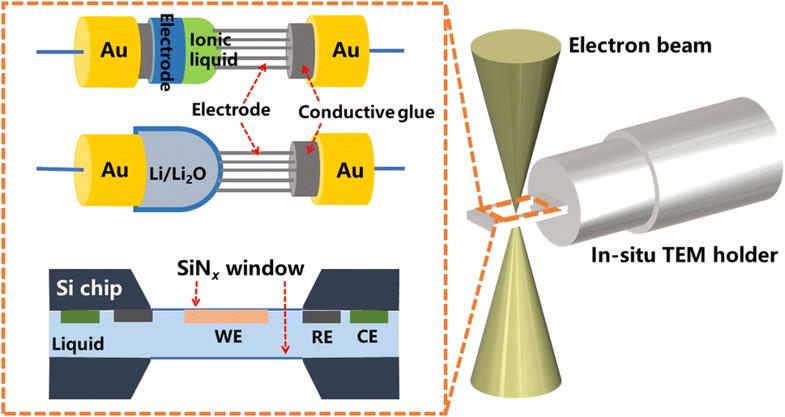
Key words: In situ TEM; Liquid cell; Reaction mechanism; Rechargeable battery
Xiaoyu Wu , Songmei Li , Bin Yang , Chongmin Wang . In Situ Transmission Electron Microscopy Studies of Electrochemical Reaction Mechanisms in Rechargeable Batteries[J]. Electrochemical Energy Reviews, 2019 , 2(3) : 467 -491 . DOI: 10.1007/s41918-019-00046-2
/
| 〈 |
|
〉 |