Electrochemical Energy Reviews >
Lithium Metal Anode Materials Design: Interphase and Host
Received date: 2019-02-10
Revised date: 2019-04-23
Online published: 2020-03-28
Supported by
We acknowledge the support from the Assistant Secretary for Energy Efciency and Renewable Energy, Ofce of Vehicle Technologies, Battery Materials Research (BMR) and Battery 500 Program of the US Department of Energy. Yayuan L. acknowledges the support from Stanford University through the Stanford Graduate Fellowship. Yuzhang L. acknowledges the Intelligence Community Fellowship for funding.
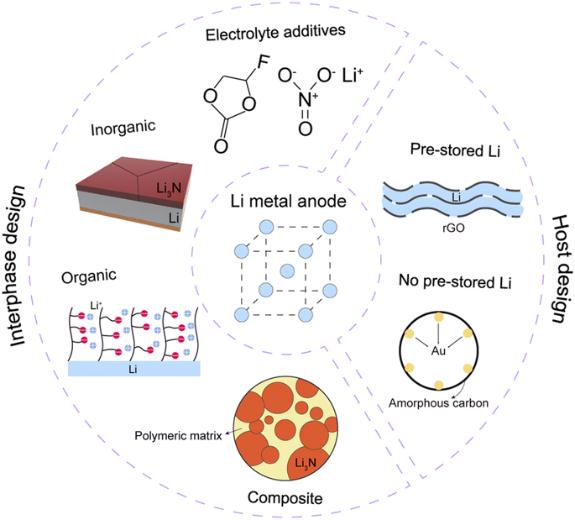
Li metal is the ultimate anode choice due to its highest theoretical capacity and lowest electrode potential, but it is far from practical applications with its poor cycle lifetime. Recent research progresses show that materials designs of interphase and host structures for Li metal are two efective ways addressing the key issues of Li metal anodes. Despite the exciting improvement on Li metal cycling capability, problems still exist with these methodologies, such as the defcient long-time cycling stability of interphase materials and the accelerated Li corrosion for high surface area three-dimensional composite Li anodes. As a result, Coulombic efciency of Li metal is still not sufcient for full-cell cycling. In the near future, an interphase protected three-dimensional composite Li metal anode, combined with high performance novel electrolytes might be the ultimate solution. Besides, nanoscale characterization technologies are also vital for guiding future Li metal anode designs.
Full-text:https://link.springer.com/article/10.1007/s41918-019-00054-2
Key words: Lithium metal anode; Interphase; Host; Electrolyte; Cryo-EM
Hansen Wang , Yayuan Liu , Yuzhang Li , Yi Cui . Lithium Metal Anode Materials Design: Interphase and Host[J]. Electrochemical Energy Reviews, 2019 , 2(4) : 509 -517 . DOI: 10.1007/s41918-019-00054-2
/
| 〈 |
|
〉 |