Electrochemical Energy Reviews >
Single-Atom Catalysts: From Design to Application
Received date: 2019-02-19
Revised date: 2019-04-17
Online published: 2020-03-28
Supported by
This work was supported by the Natural Sciences and Engineering Research Council of Canada (NSERC), the Canada Research Chair (CRC) Program, the Canada Foundation for Innovation (CFI) and the University of Western Ontario.
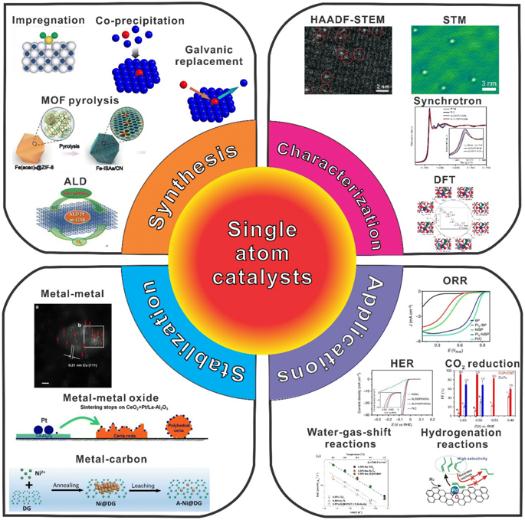
Single-atom catalysis is a powerful and attractive technique with exceptional performance, drastic cost reduction and notable catalytic activity and selectivity. In single-atom catalysis, supported single-atom catalysts contain isolated individual atoms dispersed on, and/or coordinated with, surface atoms of appropriate supports, which not only maximize the atomic efciency of metals, but also provide an alternative strategy to tune the activity and selectivity of catalytic reactions. This review will highlight the attributes of single-atom catalysis and summarize the most recent advancements in single-atom catalysts with a focus on the design of highly active and stable single atoms. In addition, new research directions and future trends will also be discussed.
Full-text:https://link.springer.com/article/10.1007/s41918-019-00050-6
Niancai Cheng, Lei Zhang, Kieran Doyle, Davis, Xueliang Sun . Single-Atom Catalysts: From Design to Application[J]. Electrochemical Energy Reviews, 2019 , 2(4) : 539 -573 . DOI: 10.1007/s41918-019-00050-6
/
| 〈 |
|
〉 |