Perovskite Cathode Materials for Low-Temperature Solid Oxide Fuel Cells: Fundamentals to Optimization

Expand
  • 1. School of Chemical Engineering, The University of Queensland, Brisbane, 4072, Australia;
    2. School of Chemical Engineering, China University of Petroleum, Qingdao, 266555, Shandong, China

Received date: 2020-08-05

  Revised date: 2020-10-13

  Online published: 2022-06-11

Supported by

Z. Li acknowledges the financial support from the China Scholarship Council (CSC). M. Li acknowledges the financial support from the HBIS Group and the Australian Research Council (ARC) Linkage Project (LP160101729). Z. Zhu acknowledges the financial support from the ARC Discovery Projects (DP170104660 and DP190101782).
Abstract

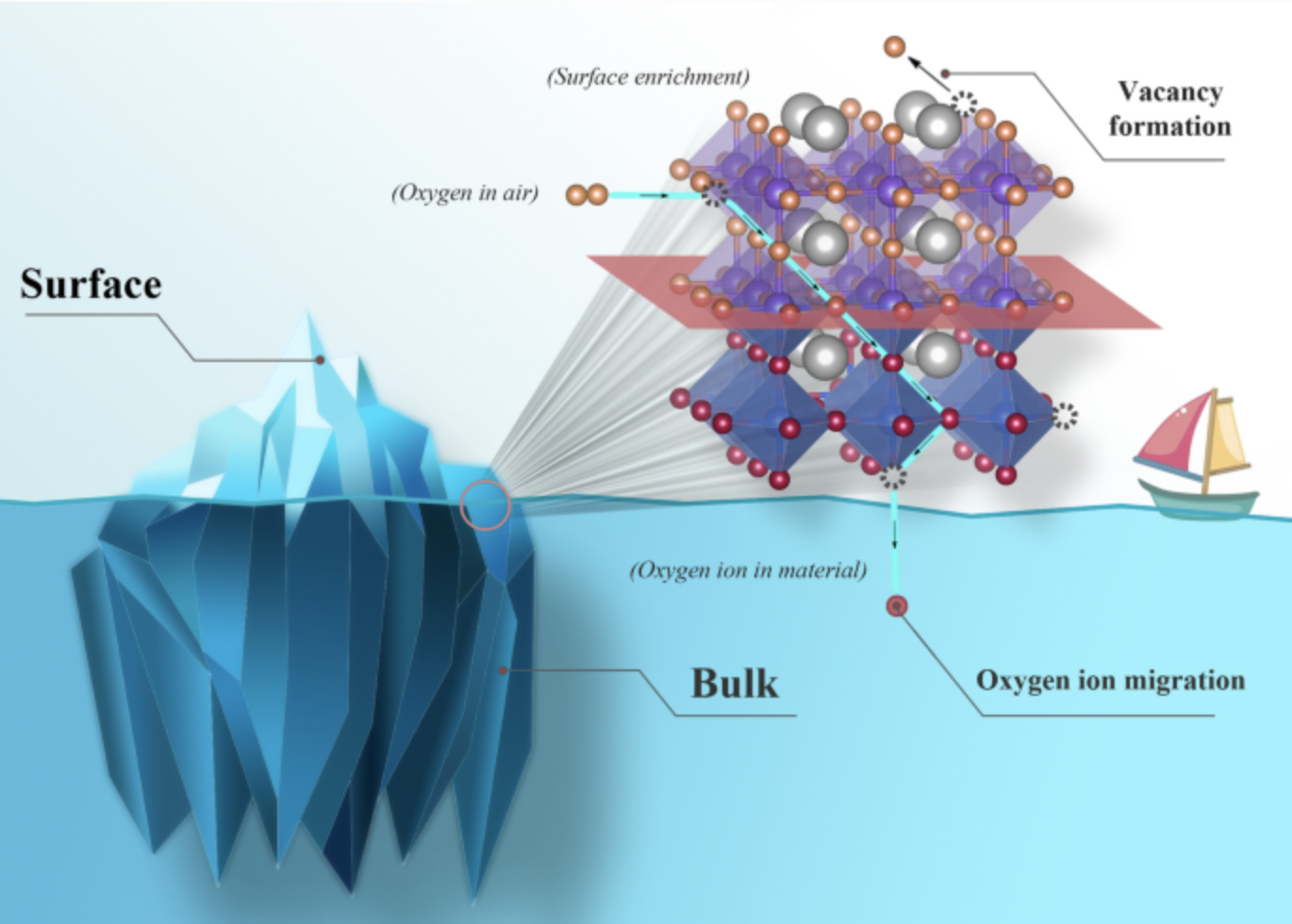
Acceleration of the oxygen reduction reaction at the cathode is paramount in the development of low-temperature solid oxide fuel cells. At low operating temperatures between 450 and 600℃, the interactions between the surface and the bulk of the cathode materials greatly impact the electrode kinetics and consequently determine the overall efficacy and long-term stability of the fuel cells. This review will provide an overview of the recent progress in the understanding of surface-bulk interactions in perovskite oxides as well as their impact on cathode reactivity and stability. This review will also summarize current strategies in the development of cathode materials through bulk doping and surface functionalization. In addition, this review will highlight the roles of surface segregation in the mediation of surface and bulk interactions, which have profound impacts on the properties of cathode surfaces and the bulk and therefore overall cathode performance. Although trade-offs between reactivity and stability commonly exist in terms of catalyst design, opportunities also exist in attaining optimal cathode performance through the modulation of both cathode surfaces and bulk using combined strategies. This review will conclude with future research directions involving investigations into the role of oxygen vacancy and mobility in catalysis, the rational modulation of surface-bulk interactions and the use of advanced fabrication techniques, all of which can lead to optimized cathode performance.

Cite this article

Zhiheng Li, Mengran Li, Zhonghua Zhu . Perovskite Cathode Materials for Low-Temperature Solid Oxide Fuel Cells: Fundamentals to Optimization[J]. Electrochemical Energy Reviews, 2022 , 5(2) : 263 -311 . DOI: 10.1007/s41918-021-00098-3

Options
Outlines

/