Insight into Cellulose Nanosizing for Advanced Electrochemical Energy Storage and Conversion: A Review

Expand
  • 1. State Key Laboratory of Polymer Materials Engineering, Polymer Research Institute, Sichuan University, Chengdu 610065, Sichuan, China;
    2. State Key Laboratory of Environment-Friendly Energy Materials, Southwest University of Science and Technology, Mianyang 621010, China;
    3. School of Materials Science and Engineering, Nanyang Technological University, 50 Nanyang Avenue, Singapore 639798, Singapore

Received date: 2021-08-21

  Revised date: 2021-11-23

  Online published: 2022-10-25

Supported by

This work was supported by the National Natural Science Foundation of China (Nos. 51933007, 51673123, 51803141), National Key R&D Program of China (No. 2017YFE0111500).
Abstract

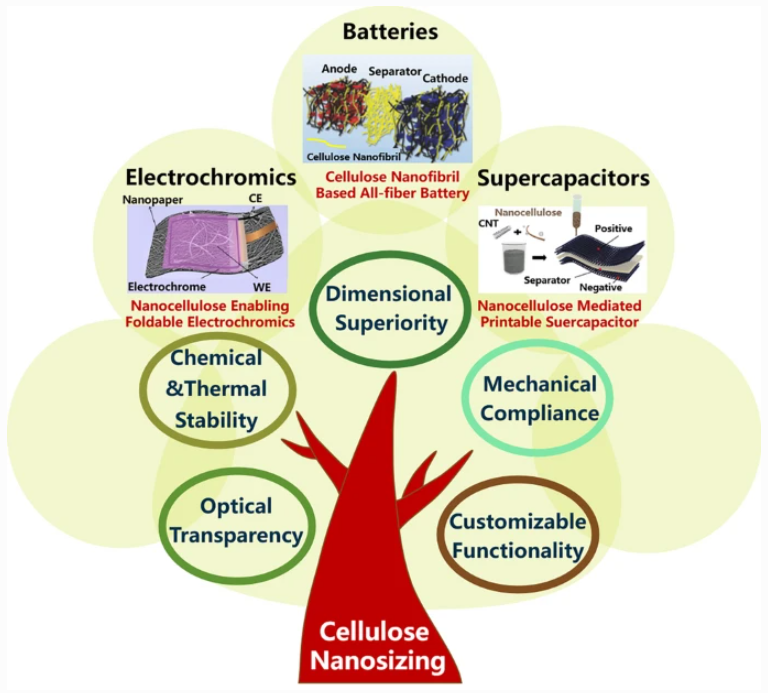
Living in a world of heavy industrialization and confronted by the ever-deteriorating environment, the human race is now undertaking serious efforts to reach the target of carbon neutrality. One major step is to promote the development of sustainable electrochemical energy storage and conversion technologies based on green resources instead of the traditional nonreusable petroleum-based technologies. As an almost inexhaustible bioresource, nanocellulose derived from natural biomass exhibits outstanding physiochemical properties that could be well leveraged to bring about numerous opportunities for electrochemical processes. Through structure engineering, nanocellulose with a width of a few tens of nanometers and a length of up to micrometers could be realized. The drastic reduction in dimensions leads to superior mechanical, optical, and functional properties inaccessible to the bulky cellulose counterpart. In this review, different types of nanocellulose with distinctive physiochemical properties and their respective preparation methods are first examined. This is followed by a detailed and insightful analysis of the superiority and unprecedented performance gains that nanocellulose imparts to different electrochemical energy storage and conversion applications as a result of nanosizing. Finally, we humbly put forward our perspectives on the problems regarding current studies as well as on the future research direction for nanocellulose-mediated electrochemical processes to enable practical applications. This review is intended as guidance to initiate cross-disciplinary research effort in this engaging field and help evoke inspiration to effect solutions to critical energy issues of the day.

Cite this article

Wenbin Kang, Li Zeng, Xingang Liu, Hanna He, Xiaolong Li, Wei Zhang, Pooi See Lee, Qi Wang, Chuhong Zhang . Insight into Cellulose Nanosizing for Advanced Electrochemical Energy Storage and Conversion: A Review[J]. Electrochemical Energy Reviews, 2022 , 5(3) : 8 . DOI: 10.1007/s41918-022-00151-9

Options
Outlines

/