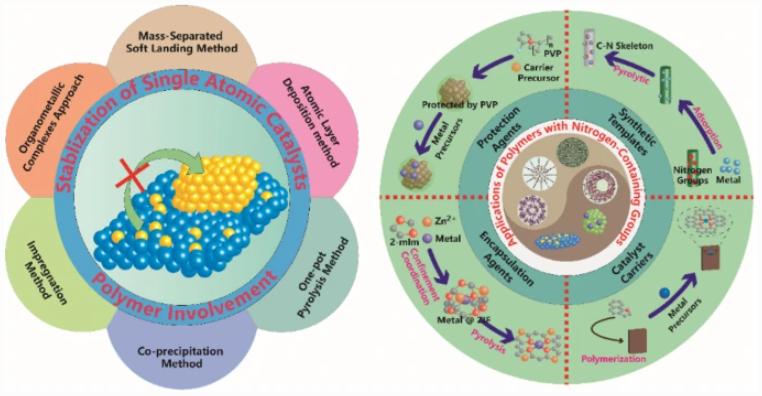
Well-defined atomically dispersed metal catalysts (or single-atom catalysts) have been widely studied to fundamentally understand their catalytic mechanisms, improve the catalytic efficiency, increase the abundance of active components, enhance the catalyst utilization, and develop cost-effective catalysts to effectively reduce the usage of noble metals. Such single-atom catalysts have relatively higher selectivity and catalytic activity with maximum atom utilization due to their unique characteristics of high metal dispersion and a low-coordination environment. However, freestanding single atoms are thermodynamically unstable, such that during synthesis and catalytic reactions, they inevitably tend to agglomerate to reduce the system energy associated with their large surface areas. Therefore, developing innovative strategies to stabilize single-atom catalysts, including mass-separated soft landing, one-pot pyrolysis, co-precipitation, impregnation, atomic layer deposition, and organometallic complexation, is critically needed. Many types of supporting materials, including polymers, have been commonly used to stabilize single atoms in these fabrication techniques. Herein, we review the stabilization strategies of single-atom catalyst, including different synthesis methods, specific metals and carriers, specific catalytic reactions, and their advantages and disadvantages. In particular, this review focuses on the application of polymers in the synthesis and stabilization of single-atom catalysts, including their functions as carriers for metal single atoms, synthetic templates, encapsulation agents, and protection agents during the fabrication process. The technical challenges that are currently faced by single-atom catalysts are summarized, and perspectives related to future research directions including catalytic mechanisms, enhancement of the catalyst loading content, and large-scale implementation are proposed to realize their practical applications.
Wenxian Li, Zehao Guo, Jack Yang, Ying Li, Xueliang Sun, Haiyong He, Sean Li, Jiujun Zhang
. Advanced Strategies for Stabilizing Single-Atom Catalysts for Energy Storage and Conversion[J]. Electrochemical Energy Reviews, 2022
, 5(3)
: 9
.
DOI: 10.1007/s41918-022-00169-z