Advances in Graphene-Supported Single-Atom Catalysts for Clean Energy Conversion

Expand
  • 1. MIIT Key Laboratory of Critical Materials Technology for New Energy Conversion and Storage, State Key Lab of Urban Water Resource and Environment, School of Chemistry and Chemical Engineering, Harbin Institute of Technology, Harbin, 150001, Heilongjiang, China;
    2. State Grid Heilongjiang Electric Power Co., Ltd. Electric Power Research Institute, Harbin, 150090, Heilongjiang, China;
    3. College of Materials Science and Engineering, Shenzhen University, Shenzhen, 518071, Guangdong, China

Received date: 2021-02-04

  Revised date: 2021-07-28

  Online published: 2023-02-11

Supported by

This work was financially supported by the National Natural Science Foundation of China (Grant Nos. 21673064, 51802059, 21905070 and 21503059), State Grid Heilongjiang Electric Power Co., Ltd., Technology Project Funding (52243719004s), China Postdoctoral Science Foundation (Grant Nos. 2018M631938, 2018T110307 and 2017M621284), Heilongjiang Postdoctoral Fund (LBH-Z17074 and LBH-Z18066), and Fundamental Research Funds for the Central Universities (Grant Nos. HIT. NSRIF. 2019040 and 2019041).
Abstract

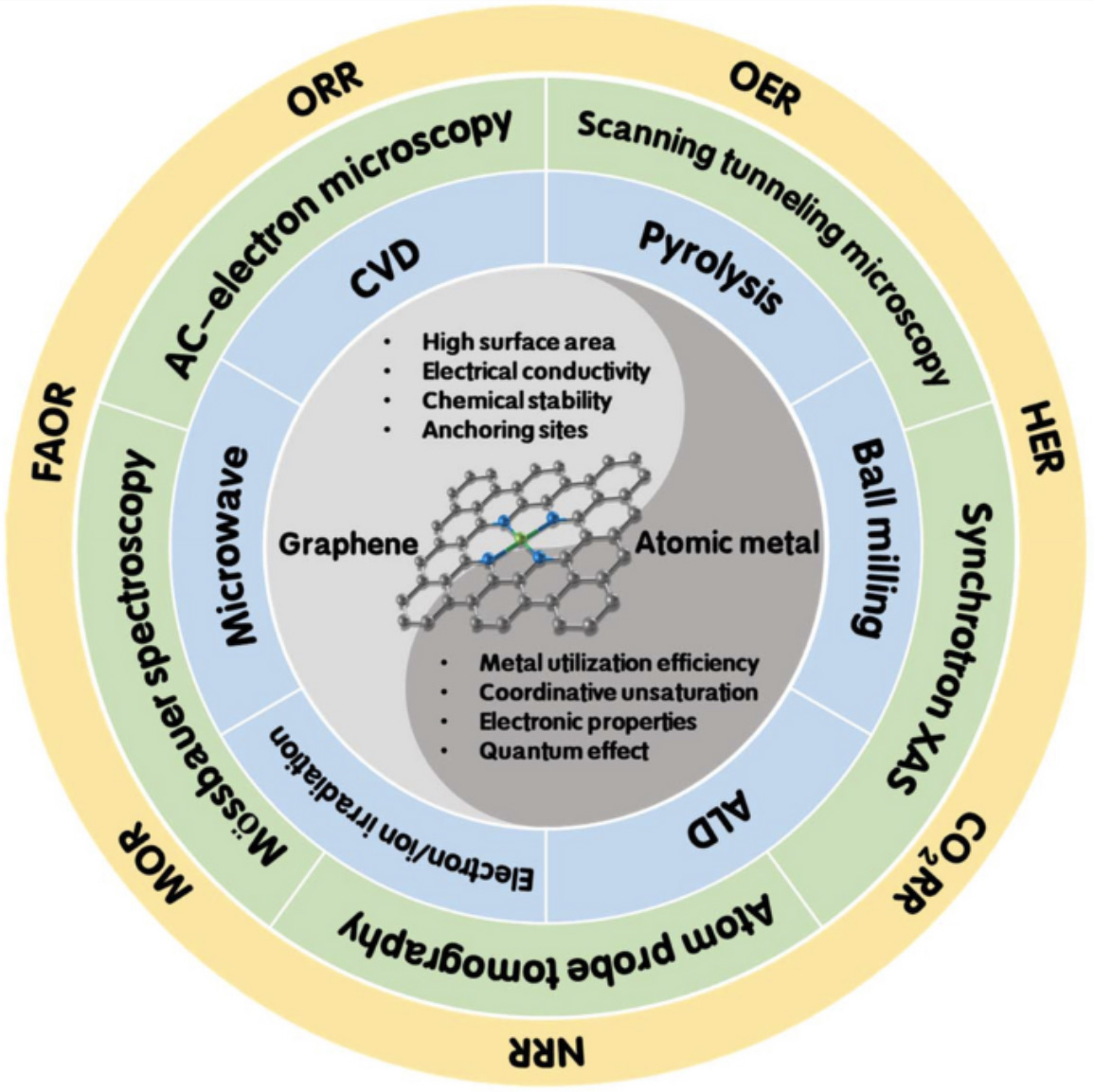
Recently, heterogeneous single-atom catalysts (SACs) have attracted enormous attention in electrochemical applications owing to their advantages of high metal utilization, well-defined active sites, tunable selectivity, and excellent activity. To avoid the aggregation of atomically dispersed metal sites, an appropriate support has to be adopted to reduce the surface free energy of catalysts. Graphene with a high surface area, outstanding conductivity, and unique electronic properties has generally been utilized as the substrate for SACs. Moreover, the correlations between metal-support interactions and the electrocatalytic performance at the atomic scale can be studied on graphene-supported single-atom catalyst (G-SAC) nanoplatforms. In this review, we start from an overview of the synthetic methods for G-SACs. Subsequently, several advanced and effective characterization techniques are discussed. Then, we present a comprehensive summary of recent progress in G-SACs for a variety of electrochemical applications. Finally, we present challenges for and an outlook on the development of G-SACs with outstanding catalytic activity, stability, and selectivity.

Cite this article

Yunkun Dai, Fanrong Kong, Xuehan Tai, Yunlong Zhang, Bing Liu, Jiajun Cai, Xiaofei Gong, Yunfei Xia, Pan Guo, Bo Liu, Jian Zhang, Lin Li, Lei Zhao, Xulei Sui, Zhenbo Wang . Advances in Graphene-Supported Single-Atom Catalysts for Clean Energy Conversion[J]. Electrochemical Energy Reviews, 2022 , 5(S2) : 22 . DOI: 10.1007/s41918-022-00142-w

Options
Outlines

/