Carbon-Based Electrodes for Advanced Zinc-Air Batteries: Oxygen-Catalytic Site Regulation and Nanostructure Design

Expand
  • 1. College of Polymer Science and Engineering, State Key Laboratory of Polymer Materials Engineering, Sichuan University, Chengdu, 610065, Sichuan, China;
    2. College of Biomass Science and Engineering, Sichuan University, Chengdu, 610065, Sichuan, China;
    3. Department of Ultrasound, West China Hospital, Sichuan University, Chengdu, 610041, Sichuan, China;
    4. Electrochemical Process Engineering, Engineering Sciences, University of Bayreuth, Universitätsstr. 30, 95447, Bayreuth, Germany;
    5. Med-X Center for Materials, Sichuan University, Chengdu, 610065, Sichuan, China;
    6. Functional Materials, Department of Chemistry, Technische Universität Berlin, Hardenbergstraße 40, 10623, Berlin, Germany

Received date: 2022-04-19

  Revised date: 2022-07-18

  Online published: 2023-06-25

Supported by

This work was financially supported by the National Key R&D Program of China (2021YFE0205000); the National Natural Science Foundation of China (Nos. 52173133, 51903178, 52161145402); the Science and Technology Project of Sichuan Province (Nos. 2022YFH0042, 2021YFH0135, 2021YJ0554); the China Postdoctoral Science Foundation (2021M692303, 2021M702334), the 1·3·5 Project for Disciplines of Excellence, West China Hospital, Sichuan University (No. ZYJC21047, 2020HXBH126); the Med-X Innovation Programme of the Med-X Center for Materials, Sichuan University (MCM202102); the State Key Laboratory of Polymer Materials Engineering (Grant No. sklpme2022-3-07, sklpme2021-4-02); and Fundamental Research Funds for the Central Universities (“Zero to One” innovative research program: 2021SCU12013).
Abstract

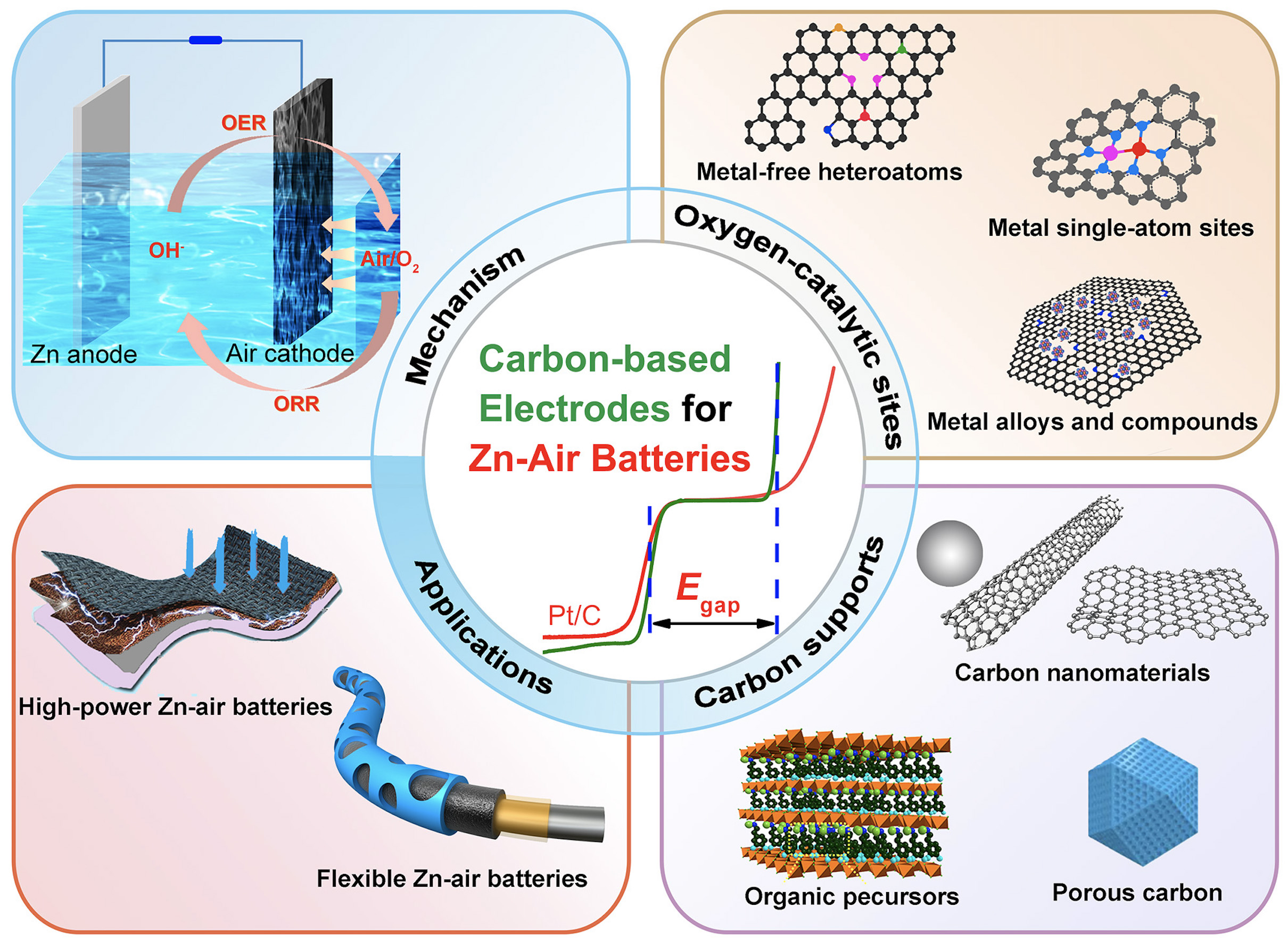
Zn-air batteries are highly attractive for direct chemical-to-electrical energy conversion and for solving the energy crisis and environmental problems. Designing efficient oxygen electrodes has been considered one of the most critical steps in the development of advanced Zn-air batteries because of the sluggish kinetics of the oxygen reduction reaction and the oxygen evolution reaction. In recent years, nanostructured carbon-based electrodes with large surface areas, efficient oxygen-catalytic centers, and hierarchically porous matrices have provided significant opportunities to optimize the performance of the oxygen electrodes in both primary and rechargeable Zn-air batteries. In this review, we provide a comprehensive summary of the reported nanostructured carbon-based electrodes for advanced Zn-air batteries in terms of tailoring the oxygen-catalytic sites and designing carbon supports. The versatile synthetic strategies, characterization methods, and in-depth understanding of the relationships between the oxygen-catalytic sites/nanostructures and the oxygen electrode performance are systematically summarized. Furthermore, we also briefly outline recent progress in engineering flexible and high-power Zn-air batteries. Ultimately, a thorough discussion of current primary challenges and future perspectives on the rational design of nanostructured carbon-based oxygen electrodes is given, thus providing inspiration for the future prosperity of fast-kinetic and efficient Zn-air batteries in a broad range of energy fields.

Cite this article

Wenjie Shao, Rui Yan, Mi Zhou, Lang Ma, Christina Roth, Tian Ma, Sujiao Cao, Chong Cheng, Bo Yin, Shuang Li . Carbon-Based Electrodes for Advanced Zinc-Air Batteries: Oxygen-Catalytic Site Regulation and Nanostructure Design[J]. Electrochemical Energy Reviews, 2023 , 6(2) : 11 . DOI: 10.1007/s41918-023-00181-x

Options
Outlines

/