Addressing Transport Issues in Non-Aqueous Li–air Batteries to Achieving High Electrochemical Performance

Expand
  • 1. Department of Thermal Science and Energy Engineering, University of Science and Technology of China (USTC), Hefei, 230026, Anhui, China;
    2. School of Physics, Harbin Institute of Technology, Harbin, 150080, Heilongjiang, China

Received date: 2021-07-07

  Revised date: 2022-01-23

  Online published: 2023-06-25

Supported by

P. Tan thanks the funding support from National Natural Science Foundation of China (52006208), CAS Pioneer Hundred Talents Program (KJ2090130001), USTC Startup Program (KY2090000044), and USTC Tang Scholar (KY2090000065). X.B. Zhu thanks the financial support of Natural Science Foundation of China (21673063) and Natural Science Foundation of Heilongjiang Province (B2017005).
Abstract

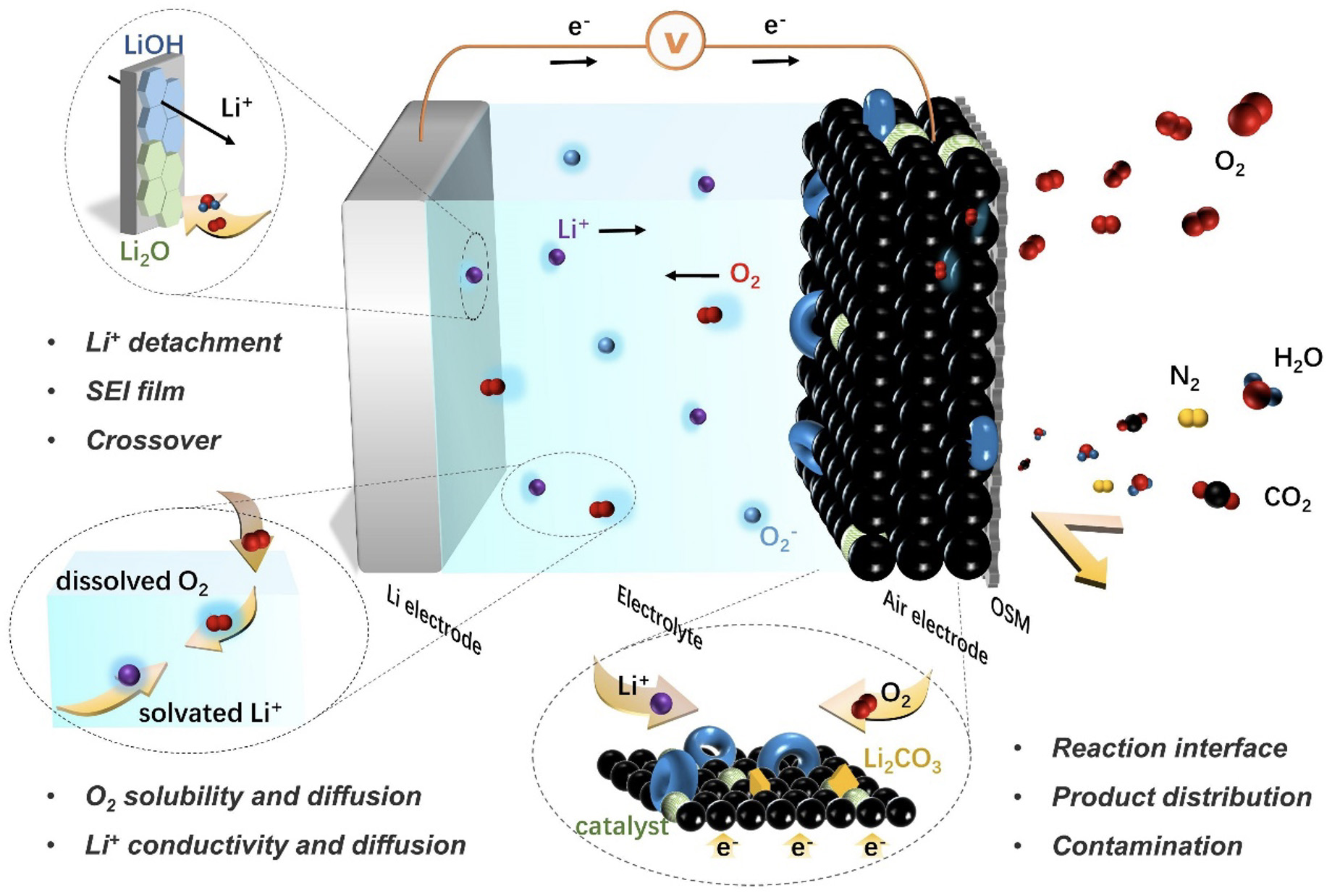
Li–air batteries are a promising type of energy storage technology because of the ultra-high theoretical specific energy. Great advances are made in recent years, including the illustration of reaction mechanisms, development of effective catalyst materials, and design of battery structures accelerating species transport. However, the application still suffers from low rate capability, poor round-trip efficiency, and unsatisfactory cycling life. Herein, we mainly focus on the species transport issues of non-aqueous Li–air batteries, including Li+ across the solid surfaces and the electrolyte, O2 solubility and diffusivity, distribution of intermediates and products, and side reactions by other components from the air. Besides, considerable emphasis is paid to expound the approaches for enhancing species transport and accelerating reactions, among which the realization of well-designed electrode structures and flowing electrolytes is of great significance for the rapid migration of O2 and Li+ and mitigating the negative effects by solid insoluble Li2O2. Moreover, optimizing reaction interfaces and operating conditions is an attractive alternative to promote reaction rates. This work aims to identify the mechanism of transport issues and corresponding challenges and perspectives, guiding the structure design and material selection to achieve high-performance Li–air batteries.

Cite this article

Zhuojun Zhang, Xu Xiao, Xingbao Zhu, Peng Tan . Addressing Transport Issues in Non-Aqueous Li–air Batteries to Achieving High Electrochemical Performance[J]. Electrochemical Energy Reviews, 2023 , 6(2) : 18 . DOI: 10.1007/s41918-022-00157-3

Options
Outlines

/