Direct Alcohol Fuel Cells: A Comparative Review of Acidic and Alkaline Systems

Expand
  • 1. Italian National Research Council (CNR)-Institute of Chemistry of OrganoMetallic Compounds (ICCOM), Via Madonna Del Piano 10, 50019, Sesto Fiorentino, Florence, Italy;
    2. Materials Physics and Applications Division, Los Alamos National Laboratory, Los Alamos, NM, 87545, USA;
    3. Italian National Research Council (CNR)-Institute for Advanced Energy Technology "Nicola Giordano" (CNR-ITAE), Via Salita S. Lucia 5, 98126, Messina, Italy;
    4. Engineering Department, University of Palermo, Viale delle Scienze, 90128, Palermo, Italy;
    5. Department of Applied Science and Technology, Politecnico di Torino, Corso Duca degli Abruzzi 24, 10129, Turin, Italy;
    6. Electrocatalysis and Bioelectrocatalysis Laboratory, Department of Material Science, University of Milano-Bicocca, Building U5, Via Cozzi 55, 20125, Milan, Italy

Received date: 2022-06-14

  Revised date: 2023-03-17

  Online published: 2023-09-18

Supported by

AL, FV, HM, JF and EB acknowledge the funding from PRIN 2017 by the Italian Ministry MUR Italy (Grant No. 2017YH9MRK). AL, FV, HM, JF, EB, VB acknowledge the Italian Ministry MISE for the FISR 2019 project AMPERE (FISR2019_01294). CS would like to thank the support from the Italian Ministry of Education, Universities and Research (Ministero dell, Istruzione, dell, Università e della Ricerca-MIUR) through the “Rita Levi Montalcini 2018” fellowship (Grant Number PGR18MAZLI).
Abstract

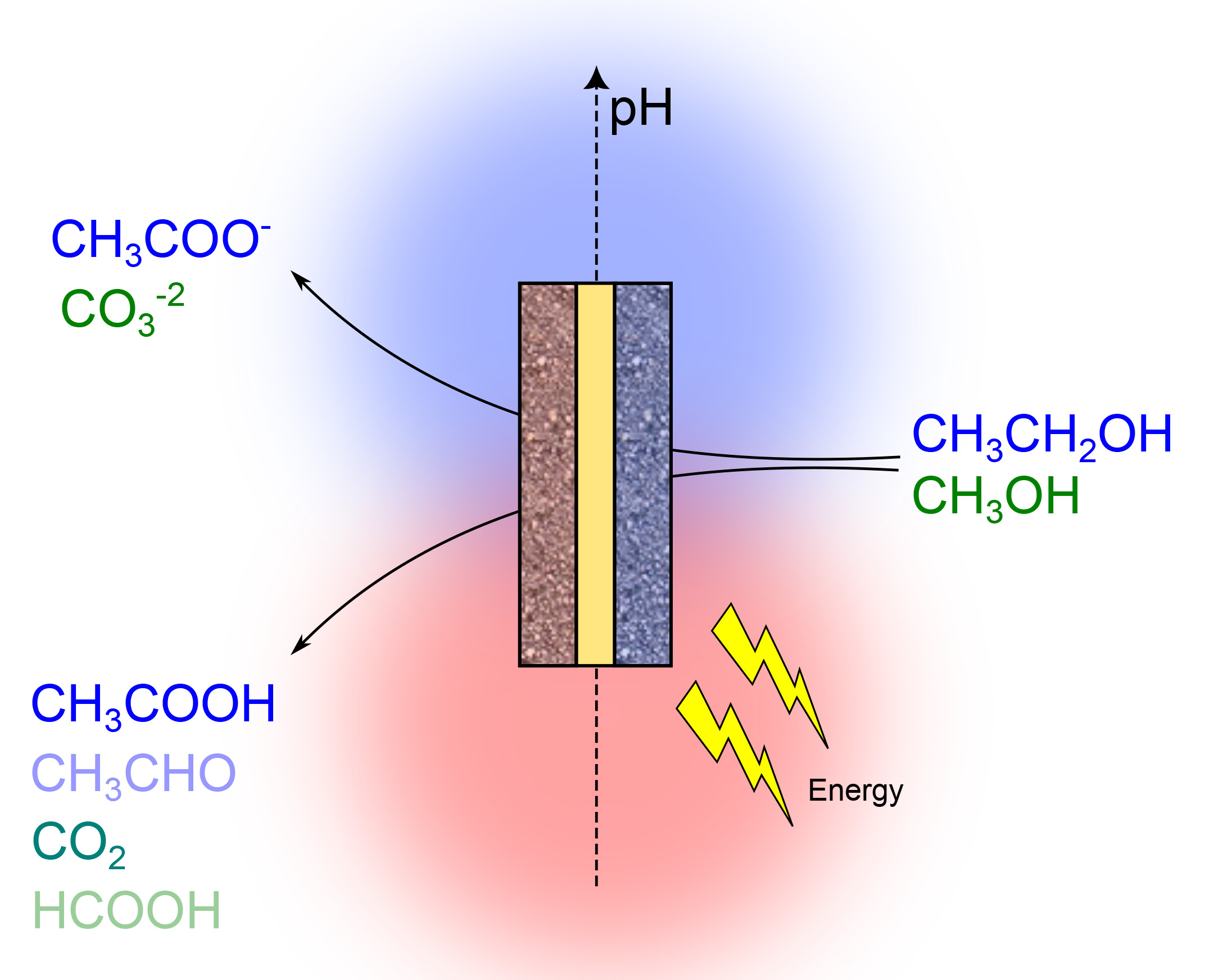
In the last 20 years, direct alcohol fuel cells (DAFCs) have been the subject of tremendous research efforts for the potential application as on-demand power sources. Two leading technologies respectively based on proton exchange membranes (PEMs) and anion exchange membranes (AEMs) have emerged: the first one operating in an acidic environment and conducting protons; the second one operating in alkaline electrolytes and conducting hydroxyl ions. In this review, we present an analysis of the state-of-the-art acidic and alkaline DAFCs fed with methanol and ethanol with the purpose to support a comparative analysis of acidic and alkaline systems, which is missing in the current literature. A special focus is placed on the effect of the reaction stoichiometry in acidic and alkaline systems. Particularly, we point out that, in alkaline systems, OH- participates stoichiometrically to reactions, and that alcohol oxidation products are anions. This aspect must be considered when designing the fuel and when making an energy evaluation from a whole system perspective.

Cite this article

Enrico Berretti, Luigi Osmieri, Vincenzo Baglio, Hamish A. Miller, Jonathan Filippi, Francesco Vizza, Monica Santamaria, Stefania Specchia, Carlo Santoro, Alessandro Lavacchi . Direct Alcohol Fuel Cells: A Comparative Review of Acidic and Alkaline Systems[J]. Electrochemical Energy Reviews, 2023 , 6(3) : 30 . DOI: 10.1007/s41918-023-00189-3

Options
Outlines

/