Electrospun Flexible Nanofibres for Batteries: Design and Application

Expand
  • 1. Institute for Ecological Research and Pollution Control of Plateau Lakes, School of Ecology and Environmental Science, Yunnan University, Kunming 650504, Yunnan, China;
    2. College of Materials Science and Technology, Nanjing University of Aeronautics and Astronautics, Nanjing 210016, Jiangsu, China;
    3. Institute for Energy Studies, University of North Dakota, Grand Forks, ND 58202, USA;
    4. Department of Advanced Components and Materials Engineering, Sunchon National University, 255 Jungang-ro, Suncheon-si, Jeollanam-do 57922, Republic of Korea;
    5. Department of Mechanical Engineering, Khalifa University, 127788 Abu Dhabi, United Arab Emirates;
    6. Department of Physics, PSGR Krishnammal College for Women, Coimbatore, Tamil Nadu 641004, India;
    7. School of Chemistry and Chemical Engineering, Liaocheng University, Liaocheng 252000, Liaoning, China;
    8. Mechanical Engineering, National University of Singapore, Singapore 117583, Singapore

Received date: 2021-07-15

  Revised date: 2021-11-11

  Online published: 2023-12-28

Supported by

This work was supported by the National Natural Science Foundation of China (51871119, 51901100, and 22075141), High-Level Entrepreneurial and Innovative Talents Program of Jiangsu Province, NSFC-Yunnan Joint Foundation (U2002213), Double Tops Joint Fund of the Yunnan Science and Technology Bureau and Yunnan University (2019FY003025), Jiangsu Provincial Funds for Natural Science Foundation (BK20170793 and BK20180015), Six Talent Peak Project of Jiangsu Province (2018-XCL-033), China Postdoctoral Science Foundation (2018M640481), Jiangsu-Innovate UK Business Competition (BZ2017061) and Double Tops Joint Fund of the Yunnan Science and Technology Bureau and Yunnan University (2019FY003025).
Abstract

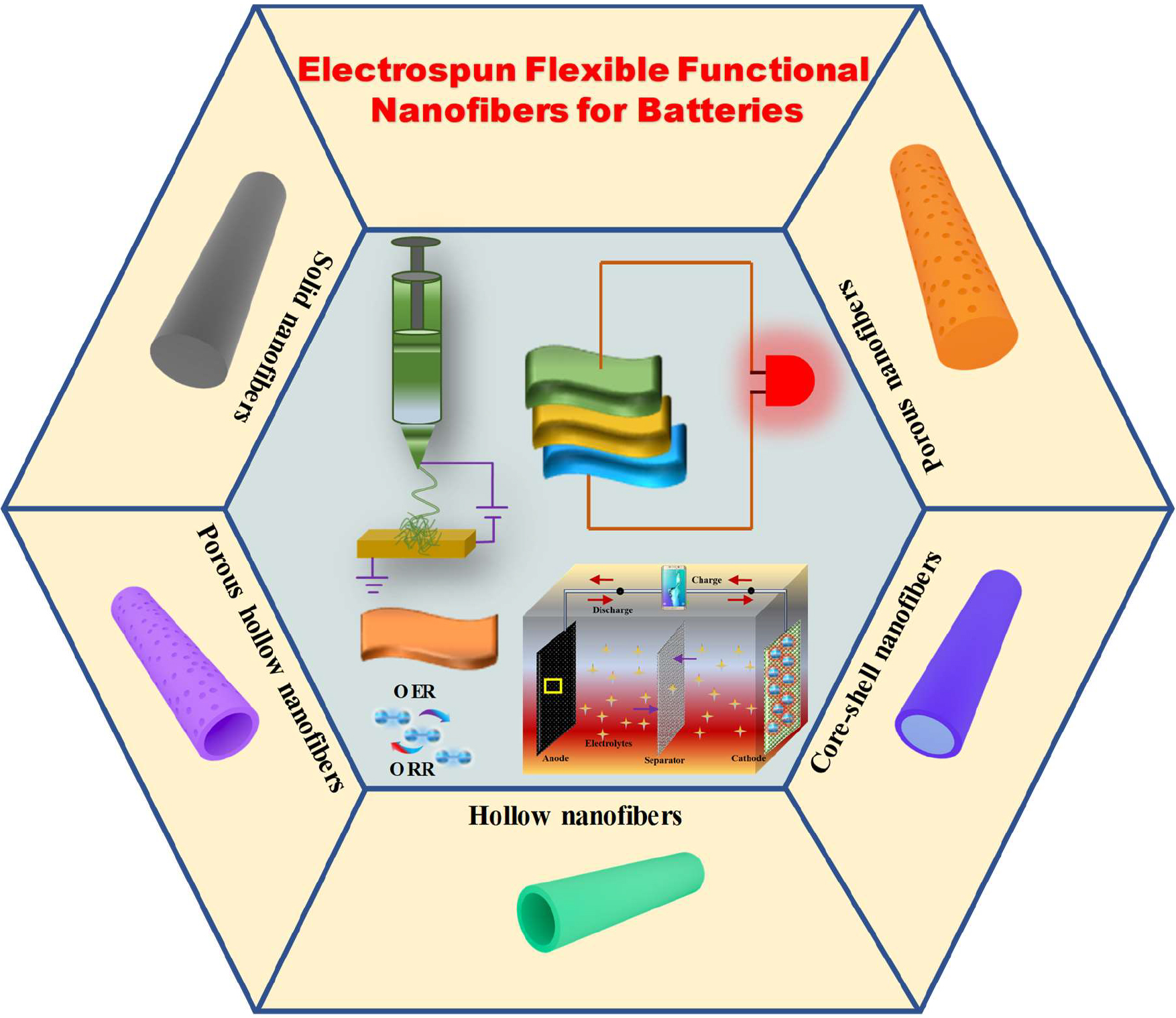
Flexible and free-standing electrospun nanofibres have been used as electrode materials in electrochemical energy storage systems due to their versatile properties, such as mechanical stability, superb electrical conductivity, and high functionality. In energy storage systems such as metal-ion, metal-air, and metal-sulphur batteries, electrospun nanofibres are vital for constructing flexible electrodes and substantially enhancing their electrochemical properties. The need for flexible batteries has increased with increasing demand for new products such as wearable and flexible devices, including smartwatches and flexible displays. Conventional batteries have several semirigid to rigid components that limit their expansion in the flexible device market. The creation of flexible and wearable batteries with greater mechanical flexibility, higher energy, and substantial power density is critical in meeting the demand for these new electronic items. The implementation of carbon and carbon-derived composites into flexible electrodes is required to realize this goal. It is essential to understand recent advances and the comprehensive foundation behind the synthesis and assembly of various flexible electrospun nanofibres. The design of nanofibres, including those comprising carbon, N-doped carbon, hierarchical, porous carbon, and metal/metal oxide carbon composites, will be explored. We will highlight the merits of electrospun carbon flexible electrodes by describing porosity, surface area, binder-free and free-standing electrode construction, cycling stability, and performance rate. Significant scientific progress has been achieved and logistical challenges have been met in promoting secondary battery usage; therefore, this review of flexible electrode materials will advance this easily used and sought-after technology. The challenges and prospects involved in the timely development of carbon nanofibre composite flexible electrodes and batteries will be addressed.

Cite this article

P. Robert Ilango, A. Dennyson Savariraj, Hongjiao Huang, Linlin Li, Guangzhi Hu, Huaisheng Wang, Xiaodong Hou, Byung Chul Kim, Seeram Ramakrishna, Shengjie Peng . Electrospun Flexible Nanofibres for Batteries: Design and Application[J]. Electrochemical Energy Reviews, 2023 , 6(4) : 31 . DOI: 10.1007/s41918-022-00148-4

Options
Outlines

/