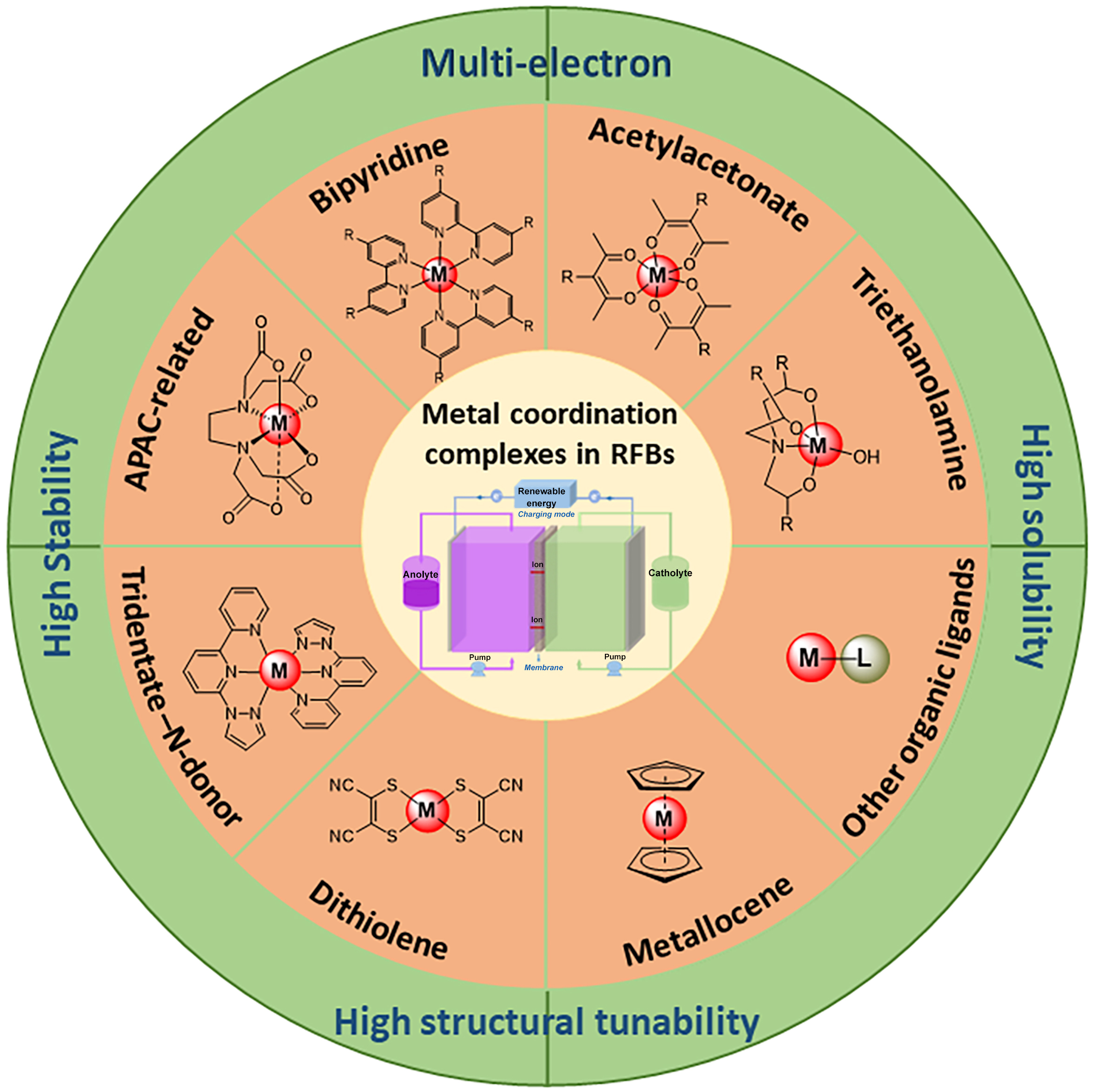
Redox flow batteries (RFBs) that employ sustainable, abundant, and structure-tunable redox-active species are of great interest for large-scale energy storage. As a vital class of redox-active species, metal coordination complexes (MCCs) possessing the properties of both the organic ligands and transition metal ion centers are attracting increasing attention due to the advantages of multielectron charge transfer, high structural tailorability, and reduced material crossover. Herein, we present a critical overview of RFBs that employ MCCs as redox-active materials in both aqueous and nonaqueous mediums. The progress is comprehensively summarized, including the design strategies, solubility characteristics, electrochemical properties, and battery cycling performance of MCCs. Emphasis is placed on the ligand selection and modification strategies used to tune the critical properties of MCCs, including their redox potential, solubility, cycling stability, and electron transfer redox reactions, to achieve stable cycled RFBs with a high energy density. Furthermore, we discuss the current challenges and perspectives related to the development of MCC-based RFBs for large-scale energy storage implementations.
Bin Liu, Yiju Li, Guocheng Jia, Tianshou Zhao
. Recent Advances in Redox Flow Batteries Employing Metal Coordination Complexes as Redox-Active Species[J]. Electrochemical Energy Reviews, 2024
, 7(1)
: 7
.
DOI: 10.1007/s41918-023-00205-6