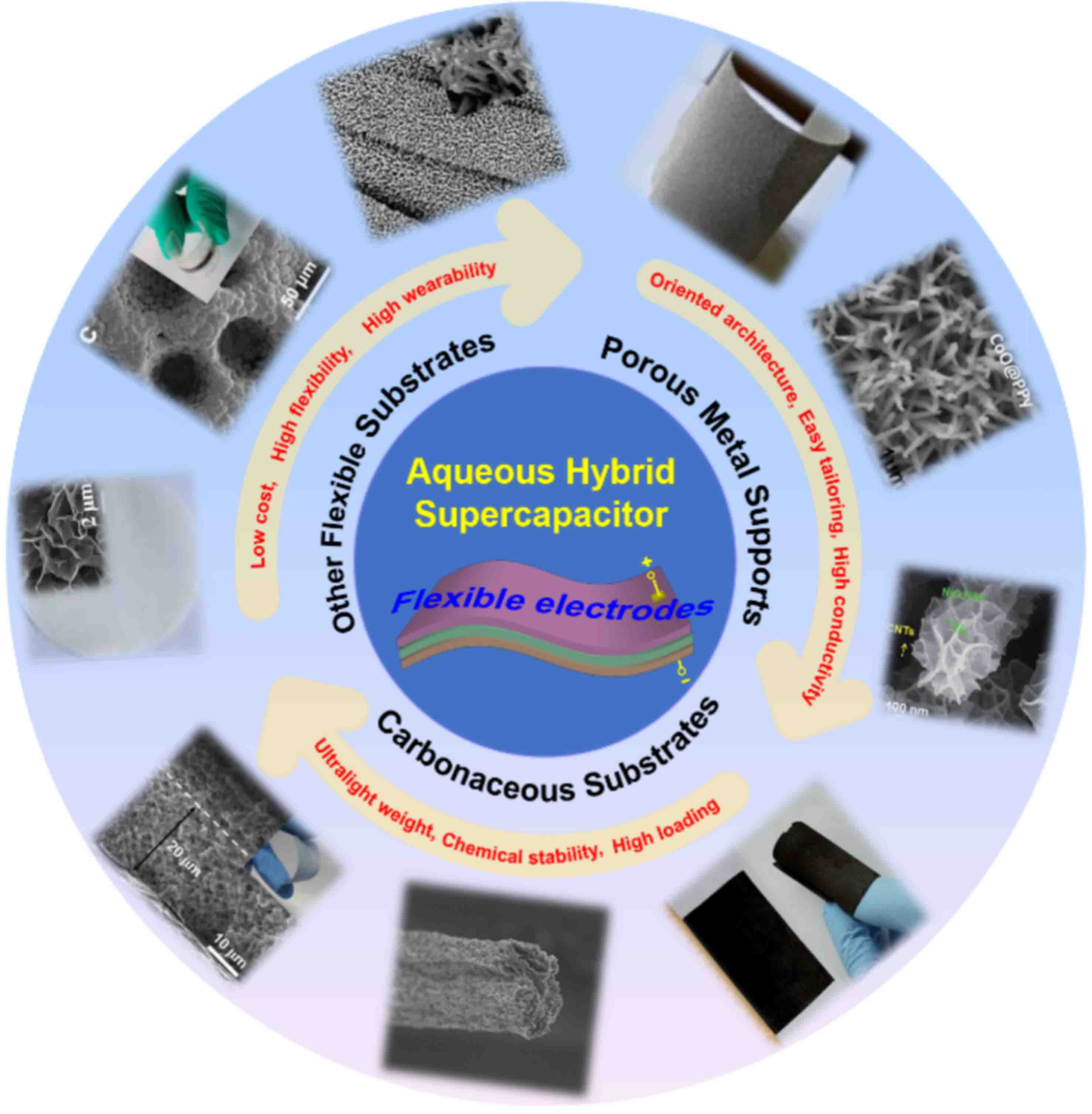
Flexible energy storage systems are promising and efficient technologies for realizing large-scale application of portable, bendable, and wearable electronic devices. Among these systems, aqueous hybrid supercapacitors (AHSs) fabricated using redox-active materials with a positive voltage window in aqueous electrolytes and capacitive carbon materials have attracted enormous attention due to their advantages, including a wide operating voltage, a high energy density, a high power density, a long cycling lifespan, and low cost. Thus far, considerable efforts have been made to develop flexible AHSs constructed from various free-standing and flexible electrodes. However, optimizing the configurations of flexible electrodes and the interfacial interaction between flexible substrates and electroactive materials to fully develop the performance through their synergistic effects remains a major challenge. Herein, we have reviewed and summarized recent advances in flexible electrode materials with a variety of configurations based on porous metal supports, carbon substrates, including carbon nanotube networks, graphene and wearable carbon (carbon fibers, carbon cloth, carbon fabric, etc.), and other flexible materials for high-performance AHSs. These flexible electrodes show unique configurations and optimized interfacial structures, resulting in excellent electrochemical performance and superior mechanical stability in AHSs under various harsh conditions, and have great potential for practical applications. Furthermore, the future directions and perspectives for constructing flexible electrodes with novel configurations and AHSs are outlined and discussed, including (1) fabrication of compressible, ultralight, or transparent flexible electrodes for special needs; (2) tailoring and tuning of interfacial properties with robust adhesion between electroactive materials and flexible substrates; (3) development of advanced in situ characterization techniques to uncover the structure evolution rules of flexible electrodes under the operation conditions; (4) matching and optimization of flexible positive and negative electrode materials to assemble advanced AHS devices; (5) design of multifunctional flexible electrodes and AHSs by integrating other specific functions, etc. This timely review is believed to provide deep insights into the intensive research on flexible aqueous energy storage devices.
Siyu Liu, Juan Yang, Pei Chen, Man Wang, Songjie He, Lu Wang, Jieshan Qiu
. Flexible Electrodes for Aqueous Hybrid Supercapacitors: Recent Advances and Future Prospects[J]. Electrochemical Energy Reviews, 2024
, 7(3)
: 25
.
DOI: 10.1007/s41918-024-00222-z