Nanoporous Carbon Materials Derived from Biomass Precursors: Sustainable Materials for Energy Conversion and Storage

Expand
  • 1. School of Materials and Energy, University of Electronic Science and Technology of China, Chengdu 611731, Sichuan, China;
    2. State Key Laboratory of Electronic Thin Films and Integrated Devices, University of Electronic Science and Technology of China, Chengdu 611731, Sichuan, China;
    3. State Key Laboratory of Catalysis, Dalian Institute of Chemical Physics, Chinese Academy of Sciences, Dalian 116023, Liaoning, China;
    4. School of Materials Science and Engineering, Xi'an University of Technology, Xi'an 710048, Shaanxi, China;
    5. DICP-Surrey Joint Centre for Future Materials, Department of Chemical and Process Engineering and Advanced Technology Institute, University of Surrey, Guilford, Surrey GU27XH, UK;
    6. College of Chemistry and Chemical Engineering, Inner Mongolia University, Hohhot 010021, Inner Mongolia, China;
    7. Curtin Mauritius, Telfair, 80809, Moka, Mauritius;
    8. Univ Lyon, CNRS, INSA-Lyon, Université Claude Bernard Lyon 1, CETHIL UMR5008, 69621 Villeurbanne, France

Received date: 2023-05-28

  Revised date: 2024-02-01

  Online published: 2024-09-23

Supported by

This research was financially supported by Key Research and Development Projects of Sichuan Province (2023YFG0222), “Tianfu Emei” Science and Technology Innovation Leader Program in Sichuan Province, University of Electronic Science and Technology of China Talent Start-up Funds (A1098 5310 2360 1208), and National Natural Science Foundation of China (21472235, 21464015).
Abstract

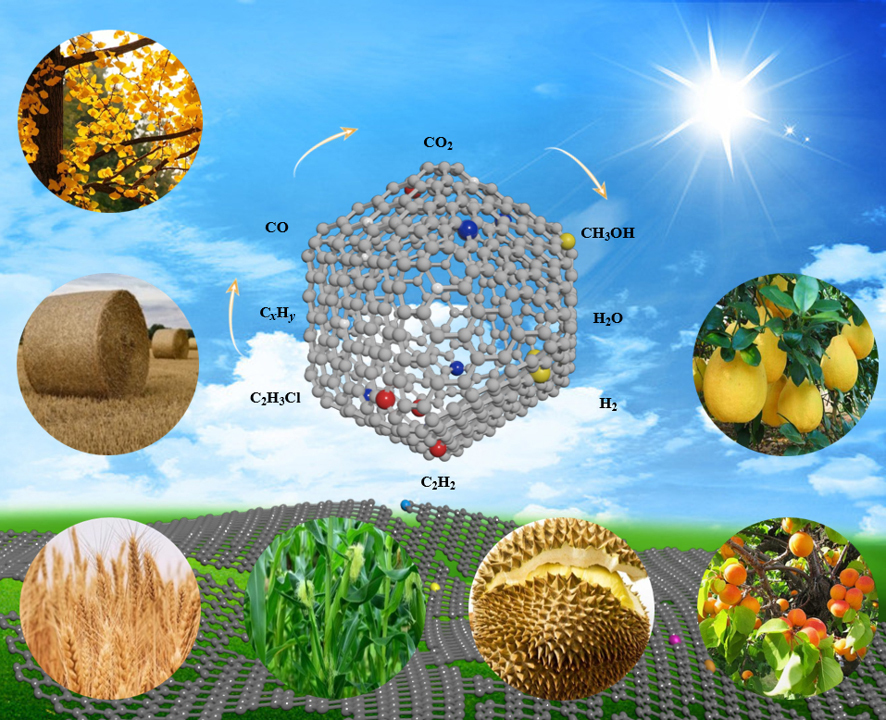
Biomass, which is derived from abundant renewable resources, is a promising alternative to fossil-fuel-based carbon materials for building a green and sustainable society. Biomass-based carbon materials (BCMs) with tailored hierarchical pore structures, large specific surface areas, and various surface functional groups have been extensively studied as energy and catalysis-related materials. This review provides insights from the perspectives of intrinsic physicochemical properties and structure-property relationships for discussing several fundamental yet significant issues in BCMs and their consequences. First, the synthesis, properties, and influencing factors of BCMs are discussed. Then, the causes and effects of the poor mechanical properties of biochar are explored. The factors affecting the properties of BCMs are presented, and the approaches for tuning these properties of biochar are summarized. Further, the applications of BCMs in energy storage and conversion are highlighted, including hydrogen storage and production, fuel cells, supercapacitors, hybrid electrodes, catalytic reforming, oxygen and CO2 reduction, and acetylene hydrochlorination. Finally, the future trends and prospects for biochar are proposed. This review aims to serve as a useful, up-to-date reference for future studies on BCMs for energy and catalytic applications.

Cite this article

Zhikai Chen, Xiaoli Jiang, Yash Boyjoo, Lan Zhang, Wei Li, Lin Zhao, Yanxia Liu, Yagang Zhang, Jian Liu, Xifei Li . Nanoporous Carbon Materials Derived from Biomass Precursors: Sustainable Materials for Energy Conversion and Storage[J]. Electrochemical Energy Reviews, 2024 , 7(3) : 26 . DOI: 10.1007/s41918-024-00223-y

Options
Outlines

/