A Review of Multiscale Mechanical Failures in Lithium-Ion Batteries: Implications for Performance, Lifetime and Safety

Expand
  • 1. Key Laboratory of Advanced Battery Systems and Safety (CPCIF), School of Mechanical and Power Engineering, East China University of Science and Technology, Shanghai 200237, China;
    2. Department of Mechanical and Aerospace Engineering, University of Strathclyde, James Weir Building, 75 Montrose Street, Glasgow G1 1XJ, UK;
    3. Institute of Science and Technology Information, East China University of Science and Technology, Shanghai 200237, China

Received date: 2023-09-01

  Revised date: 2024-04-08

  Online published: 2024-12-28

Supported by

The authors gratefully acknowledge the support from the China Scholarship Council,the National Natural Science Foundation of China (52375144,52375145 and 52205153),the China Postdoctoral Science Foundation (2022M721138 and 2023T160216),Shanghai Pujiang Programme (23PJD019),the East China University of Science and Technology,and the University of Strathclyde during the course of this work.
Abstract

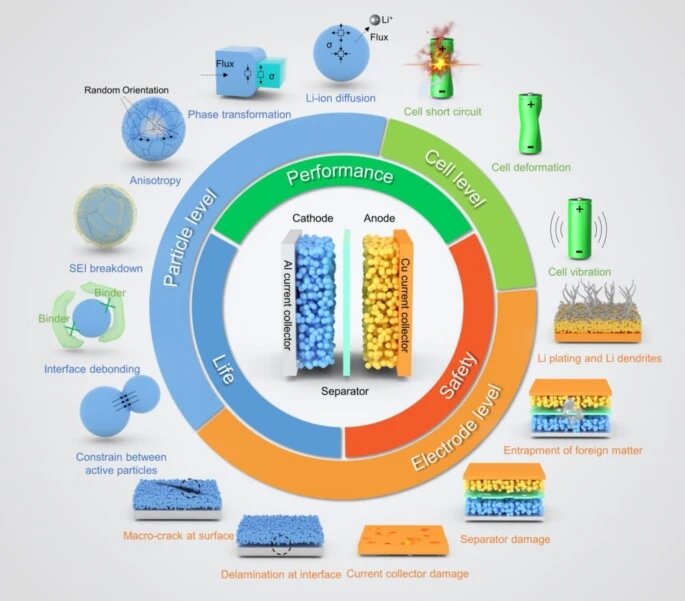
Lithium-ion batteries (LIBs) are susceptible to mechanical failures that can occur at various scales, including particle, electrode and overall cell levels. These failures are influenced by a combination of multi-physical fields of electrochemical, mechanical and thermal factors, making them complex and multi-physical in nature. The consequences of these mechanical failures on battery performance, lifetime and safety vary depending on the specific type of failure. However, the complex nature of mechanical degradation in batteries often involves interrelated processes, in which different failure mechanisms interact and evolve. Despite extensive research efforts, the detailed mechanisms behind these failures still require further clarification. To bridge this knowledge gap, this review systematically investigates three key aspects: multiscale mechanical failures; their implications for performance, lifetime and safety; and the interconnections between the different types and scales of the mechanical failures. By adopting a multiscale and multidisciplinary perspective, fragmented ideas from current research are integrated into a comprehensive framework, providing a deeper understanding of the mechanical behaviors and interactions within LIBs. We highlight the main characteristics of mechanical failures in LIBs and present valuable insights and prospects in four key areas of theories, materials, designs and applications, for improving the performance, lifetime and safety of LIBs by addressing current challenges in the field. As a valuable resource, this review may serve as a bridge for researchers from diverse disciplines, facilitating their understanding of mechanical failures in LIBs and encouraging further advancements in the field.

Cite this article

Senming Wu, Ying Chen, Weiling Luan, Haofeng Chen, Liping Huo, Meng Wang, Shan-tung Tu . A Review of Multiscale Mechanical Failures in Lithium-Ion Batteries: Implications for Performance, Lifetime and Safety[J]. Electrochemical Energy Reviews, 2024 , 7(4) : 35 . DOI: 10.1007/s41918-024-00233-w

Options
Outlines

/