Organic Electrode Materials for Lithium/Sodium/Potassium-Ion Batteries: Synthesis, Characterizations, Functional Mechanisms, and Performance Validation

  • Wenrui Wei ,
  • Chenrui Zhang ,
  • Xianxia Yuan ,
  • Jiujun Zhang
Expand
  • 1. School of Chemistry and Chemical Engineering, Shanghai Jiao Tong University, Shanghai 200240, China;
    2. Institute for New Energy Materials and Engineering, College of Materials Science and Engineering, Fuzhou University, Fuzhou 315108, China

Received date: 2024-09-23

  Revised date: 2025-03-11

  Online published: 2025-11-12

Supported by

This work was financially supported by the National Key Research and Development Program of China (2023YFB3809300).
Abstract

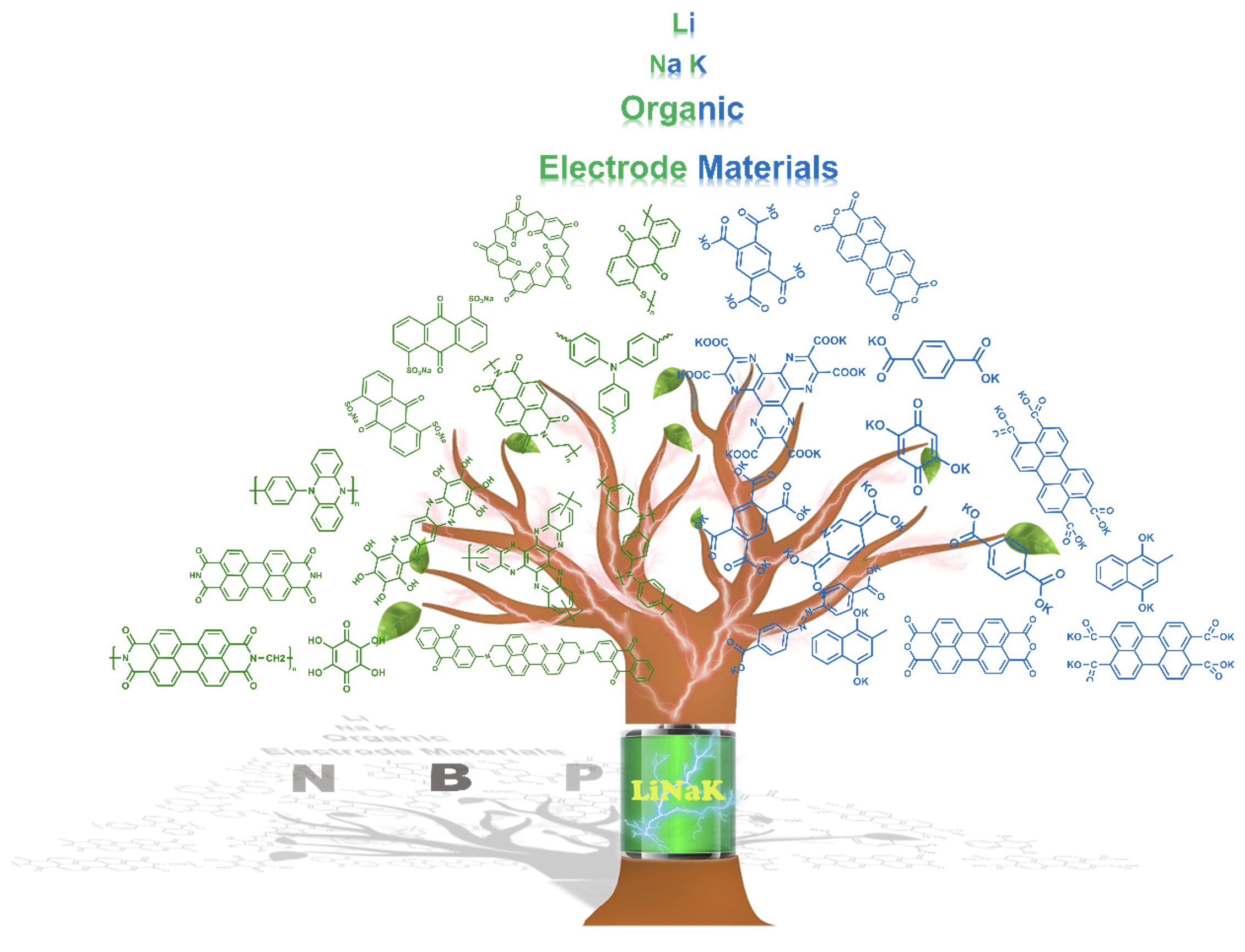
Organic electrode materials (OEMs) with cost-effectiveness, environment friendliness, tunable composition, structure diversity, and versatile functionalities can provide a great scope for the development of alkali metal-ion batteries (AMIBs) including lithium-, sodium-, and potassium-ion batteries. However, their high solubility in liquid organic electrolytes, low intrinsic conductivities, limited reversible capacities, and poor rate/cycling performance present significant obstacles to achieving widespread applications. To improve the practical performance of OEMs in AMIBs, numerous endeavors have been conducted in recent years, and great advances have been achieved. In this paper, the recent progress of OEMs in AMIBs is systematically reviewed in terms of their synthesis, characterization, functional mechanisms, and performance validation. The technical challenges are analyzed, and the perspectives and future research directions are proposed for overcoming the challenges toward the practical application of alkali metal-ion batteries.

Cite this article

Wenrui Wei , Chenrui Zhang , Xianxia Yuan , Jiujun Zhang . Organic Electrode Materials for Lithium/Sodium/Potassium-Ion Batteries: Synthesis, Characterizations, Functional Mechanisms, and Performance Validation[J]. Electrochemical Energy Reviews, 2025 , 8(3) : 13 . DOI: 10.1007/s41918-025-00250-3

Options
Outlines

/