Fundamental Mechanisms, Synthesis Strategies and Key Challenges of Transition Metal Borides for Electrocatalytic Hydrogen Evolution

  • Tongzhou Hong ,
  • Chengzhi Xiao ,
  • Jin Jia ,
  • Yuanyuan Zhu ,
  • Qiang Wang ,
  • Yu Liang ,
  • Xiao Wang ,
  • Bentian Zhang ,
  • Guang Zhu ,
  • Zhong-Shuai Wu
Expand
  • 1. School of Mechanics and Optoelectronics Physics, Anhui University of Science and Technology, Huainan 232001, Anhui, China;
    2. Key Laboratory of Spin Electron and Nanomaterials of Anhui Higher Education Institutes, Suzhou University, Suzhou 234000, Anhui, China;
    3. State Key Laboratory of Catalysis, Dalian Institute of Chemical Physics, Chinese Academy of Sciences, Dalian 116023, Liaoning, China;
    4. College of Chemistry and Materials Engineering, Anhui Science and Technology University, Bengbu, 233030, Anhui, China;
    5. Liaoning Binhai Laboratory, Dalian 116000, Liaoning, China

Received date: 2025-03-01

  Revised date: 2025-05-26

  Online published: 2025-11-12

Supported by

This work was financially supported by the National Natural Science Foundation of China (Grant No. 22125903), Anhui Provincial Natural Science Foundation (Grant No. 2408085ME108), the State Key Laboratory of Catalysis (Grant No. N-23-08), Liaoning Binhai Laboratory (Grant No. LBLD-2024-04), the Provincial of the Anhui Scientific Research Innovation Team of Photoelectric Information Materials and New Energy Devices (Grant No. 2016SCXPTTD), the Basic Research Special Program of Suzhou City Science and Technology Plan Project (Grant No. SZKJXM202404), the Support Program for Excellent Young Talents in Universities of Anhui Province (Grant No. 2022AH030134), the Doctor Research Startup Foundation of Suzhou University (Grant Nos. 2022BSK005 and 2023BSK015), the Anhui Province Higher Education Innovation Team: Key Technologies and Equipment Innovation Team for Clean Energy (Grant No. 2023AH010055). The Joint Cultivation Postgraduate Research and Innovation Fund Project of Suzhou University (Grant Nos. 2023KYCX13), and 2025KYCX01), the Talent-Introduction Program for Anhui Science and Technology University (Grant No. HCYJ202105), and the Natural Science Research Project of Higher Education in Anhui Province (Grant No. 2023AH051849).
Abstract

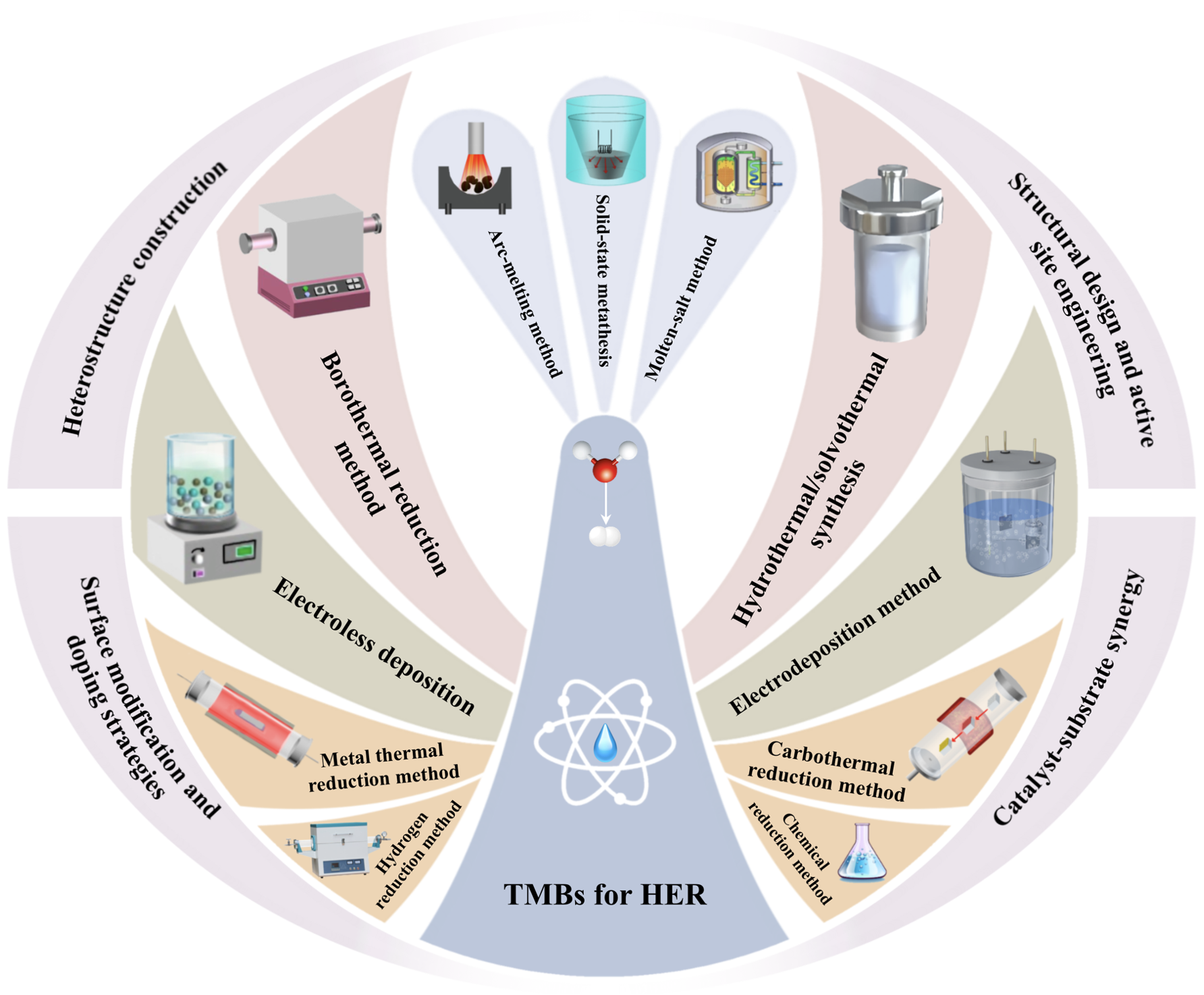
Owing to their unique electronic structures and metallic-like properties, transition metal borides (TMBs) have demonstrated activity and stability that surpass those of traditional catalysts in the hydrogen evolution reaction (HER) of water splitting, becoming a research focus in the energy materials field. However, existing research generally lacks a systematic decoupling of the multidimensional correlation mechanisms of synthetic methods, structural regulation, and performance optimisation, severely restricting the rational design process of TMB catalysts. The aim of this review is to provide a cross-scale design paradigm for the development of high-performance TMB-based HER electrocatalysts by constructing a three-in-one analytical framework of theoretical guidance, synthetic innovation, and mechanism analysis. First, based on a fundamental understanding of the HER mechanism and d-band theory, we propose core principles for designing efficient catalysts. We review various synthetic methods, from traditional methods to innovative methods, and discuss their impact on catalytic performance. Through an in-depth analysis of the correlation between synthetic parameters and HER activity, valuable insights are provided for researchers seeking to optimise TMB-based electrocatalysts. Finally, this review highlights the current challenges and outlines future directions, emphasising the immense potential of TMB-based electrocatalysts in advancing sustainable hydrogen production.

Cite this article

Tongzhou Hong , Chengzhi Xiao , Jin Jia , Yuanyuan Zhu , Qiang Wang , Yu Liang , Xiao Wang , Bentian Zhang , Guang Zhu , Zhong-Shuai Wu . Fundamental Mechanisms, Synthesis Strategies and Key Challenges of Transition Metal Borides for Electrocatalytic Hydrogen Evolution[J]. Electrochemical Energy Reviews, 2025 , 8(3) : 17 . DOI: 10.1007/s41918-025-00255-y

Options
Outlines

/