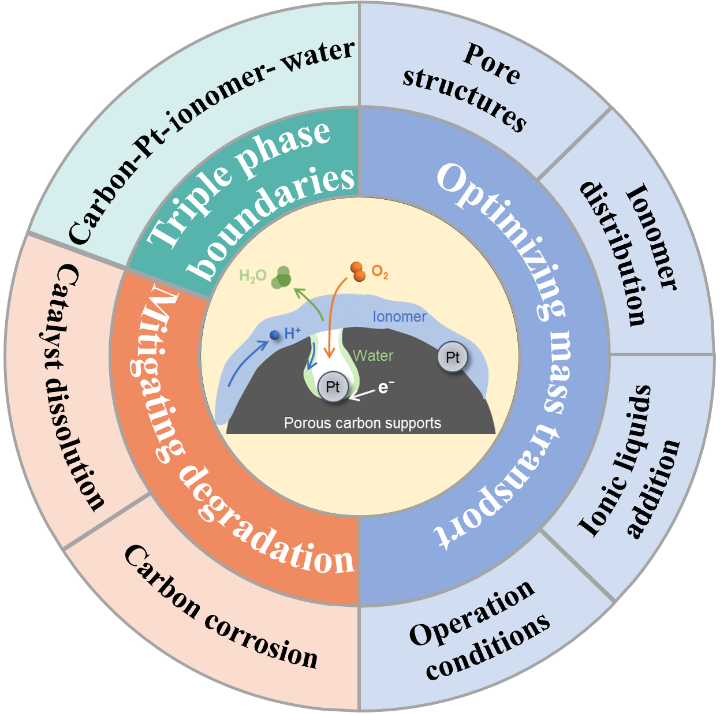
Attaining both high performance and long-term durability remains a critical yet challenging objective for low-Pt proton-exchange membrane fuel cells (PEMFCs). The carbon support on which catalysts and ionomers are dispersed strongly affects the cell performance by influencing the Pt activity, mass transport, and degradation. Currently, porous carbons endowed with a high surface area and internally embedded Pt particles are gaining prominence as promising support materials for low-Pt PEMFCs owing to their exceptional catalyst dispersion and kinetic activity. However, challenges in terms of unclear triple-phase boundaries, poor mass transport, and insufficient durability hinder their widespread implementation. Thus, this review provides a comprehensive understanding of and advanced guidelines for the exploration of porous carbons in low-Pt PEMFCs. We begin by analyzing the structures and morphologies of porous carbon catalysts to obtain an overview of their pore structures, Pt deposition, ionomer distribution, and water condensation. We subsequently summarize the mass transport mechanisms involved, exploring state-of-the-art strategies for improving mass transport through engineering accessible pore structures, tailoring uniform ionomer distributions, and incorporating well-defined ionic liquids, among other approaches. Furthermore, we highlight the effects of catalysts and porous carbon degradation on performance loss and introduce recent approaches to mitigate performance loss. Finally, we present conclusions along with outlooks on future exploration priorities. This extensive analysis of current challenges and advances in porous carbon supports is offered to inspire innovative ideas and technologies for the development of next-generation carbon supports for low-Pt PEMFCs.
Jiabin You
,
Jing Hu
,
Zhifeng Zheng
,
Huiyuan Li
,
Liuxuan Luo
,
Xiaojing Cheng
,
Xiaohui Yan
,
Shuiyun Shen
,
Junliang Zhang
. Porous Carbon Supports for Low-Pt Proton-Exchange Membrane Fuel Cells[J]. Electrochemical Energy Reviews, 2025
, 8(4)
: 22
.
DOI: 10.1007/s41918-025-00259-8