Advancements and Challenges in Aqueous Zinc-Iodine Batteries: Strategies for Enhanced Performance and Stability

  • Ling Wang ,
  • Peng Ji ,
  • Na Li ,
  • Jing Li ,
  • Yi Lin Liu ,
  • Jinpeng Guan ,
  • Zhaoyu Wang ,
  • Haiyang Fu ,
  • Yongbiao Mu ,
  • Lin Zeng
Expand
  • 1. School of Materials Science and Engineering, Hunan Key Laboratory of Electrochemical Green Metallurgy Technology, Hunan University of Technology, Zhuzhou 412007, Hunan, China;
    2. Shenzhen Key Laboratory of Advanced Energy Storage, Department of Mechanical and Energy Engineering, Southern University of Science and Technology, Shenzhen 518055, Guangdong, China;
    3. College of Mechanical Engineering, University of South China, Hengyang 421001, Hunan, China

Received date: 2025-06-26

  Revised date: 2025-10-11

  Online published: 2026-01-13

Supported by

This work was supported by the National Natural Science Foundation of China (No. 52477213, 12305352 and 52174247), the Science and Technology Innovation Program of Hunan Province (No. 2022RC1088), the Scientific Research Foundation of Hunan Provincial Education Department (No. 23A0442), Shenzhen Key Laboratory of Advanced Energy Storage (No. ZDSYS20220401141000001), and High level of special funds (No. G03034K001).
Abstract

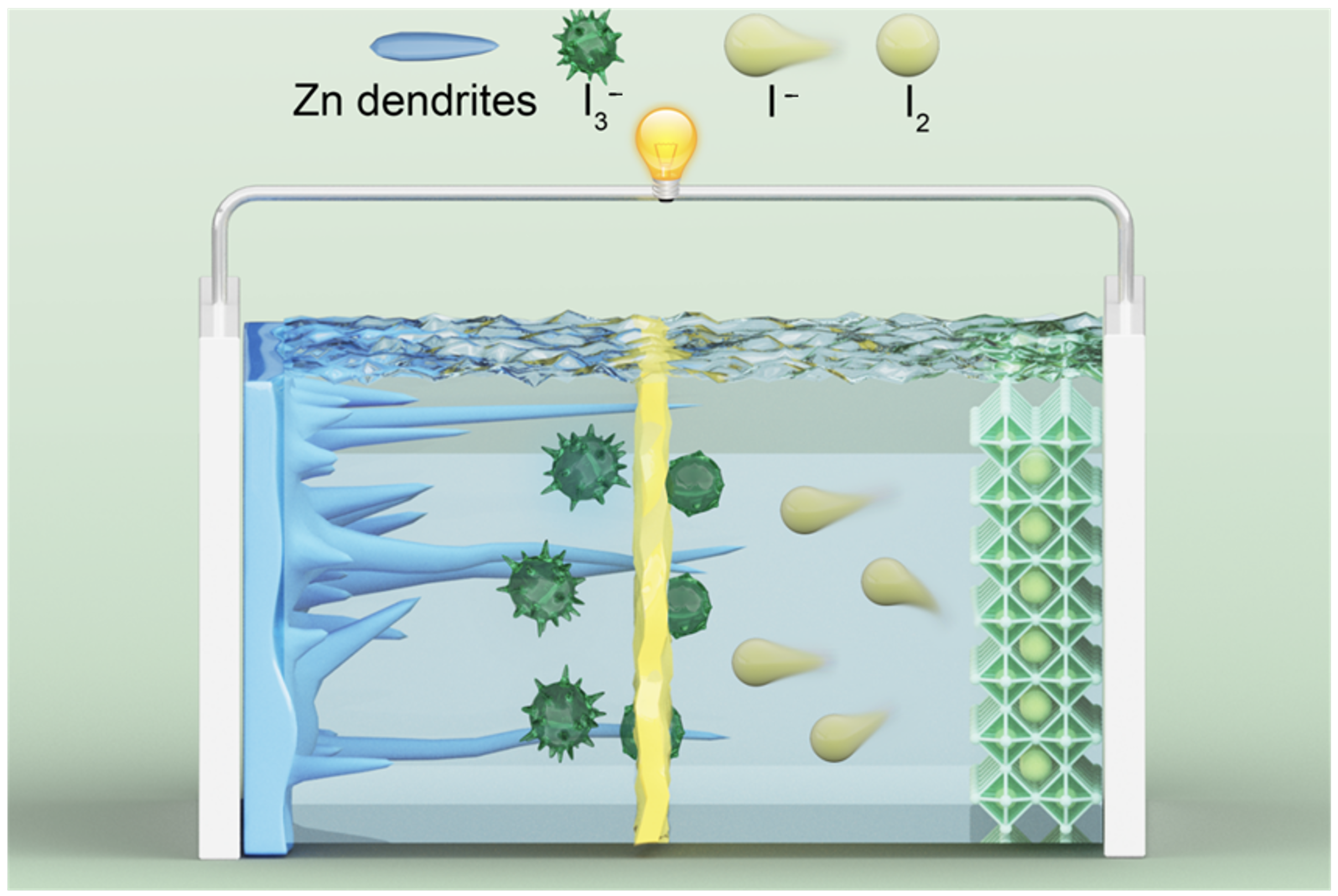
Aqueous zinc-iodine batteries (AZIBs) offer intrinsic safety, low cost, and high theoretical capacity, yet their practical performance is hindered by three coupled challenges: polyiodide shuttling that depletes active material and reduces coulombic efficiency; sluggish I2/I-/I3- redox kinetics that limit rate capability; and uncontrolled zinc dendrite growth that causes anode instability and parasitic reactions. This review summarizes recent advances addressing these issues across four domains. Cathode strategies include carbon-based hosts (hierarchical porosity, heteroatom doping, surface functionalization, electrocatalyst integration), ordered mesoporous frameworks, polymer matrices, iodine-containing perovskites, and emerging carriers. Anode designs involving artificial interfacial layers, three-dimensional zinc scaffolds, and anode-free configurations are evaluated for their ability to regulate Zn2+ flux and suppress dendrites. Separator and membrane modifications that block iodide crossover while maintaining ion transport are evaluated. Electrolyte developments encompass aqueous formulations with functional additives, water-in-salt systems, and solid/quasi-solid electrolytes that enhance stability and mechanical robustness. The review concludes with perspectives on key research priorities, including complete shuttle suppression, accelerated redox kinetics, durable dendrite control, and system-level feasibility through integrated material and interface engineering. This concise overview aims to guide the rational design of next-generation AZIBs with enhanced performance and durability.

Cite this article

Ling Wang , Peng Ji , Na Li , Jing Li , Yi Lin Liu , Jinpeng Guan , Zhaoyu Wang , Haiyang Fu , Yongbiao Mu , Lin Zeng . Advancements and Challenges in Aqueous Zinc-Iodine Batteries: Strategies for Enhanced Performance and Stability[J]. Electrochemical Energy Reviews, 2025 , 8(4) : 34 . DOI: 10.1007/s41918-025-00274-9

Options
Outlines

/