Vacancy Engineering Strategies for Water Splitting Electrocatalysts

  • Qing Zhang ,
  • Yuhai Dou ,
  • Cong Liu ,
  • Haining Fan ,
  • Mingjin Cui ,
  • Porun Liu ,
  • Hua Kun Liu ,
  • Shi Xue Dou ,
  • Ding Yuan
Expand
  • 1. Institute of Energy Materials Science, University of Shanghai for Science and Technology, Shanghai 200093, China;
    2. Centre for Computational Chemistry and Research Institute of Industrial Catalysis, East China University of Science and Technology, 130 Meilong Road, Shanghai 200237, China;
    3. Institute for Superconducting and Electronic Materials, University of Wollongong, Wollongong, NSW 2522, Australia;
    4. Centre for Catalysis and Clean Energy, School of Environment and Science, Griffith University, Gold Coast, QLD 4222, Australia

Received date: 2025-02-02

  Revised date: 2025-05-14

  Online published: 2026-01-13

Supported by

This work is financially supported by the National Overseas Postdoctoral Talent Attraction Program, the Youth Fund of the National Natural Science Foundation of China (52402288), the Young Elite Scientists Sponsorship Program by China Association for Science and Technology (YESS20230183), the Research Fund for International Senior Scientists of the National Natural Science Foundation of China (52350710795), and the Yangfan Special Program of Shanghai Star Project.
Abstract

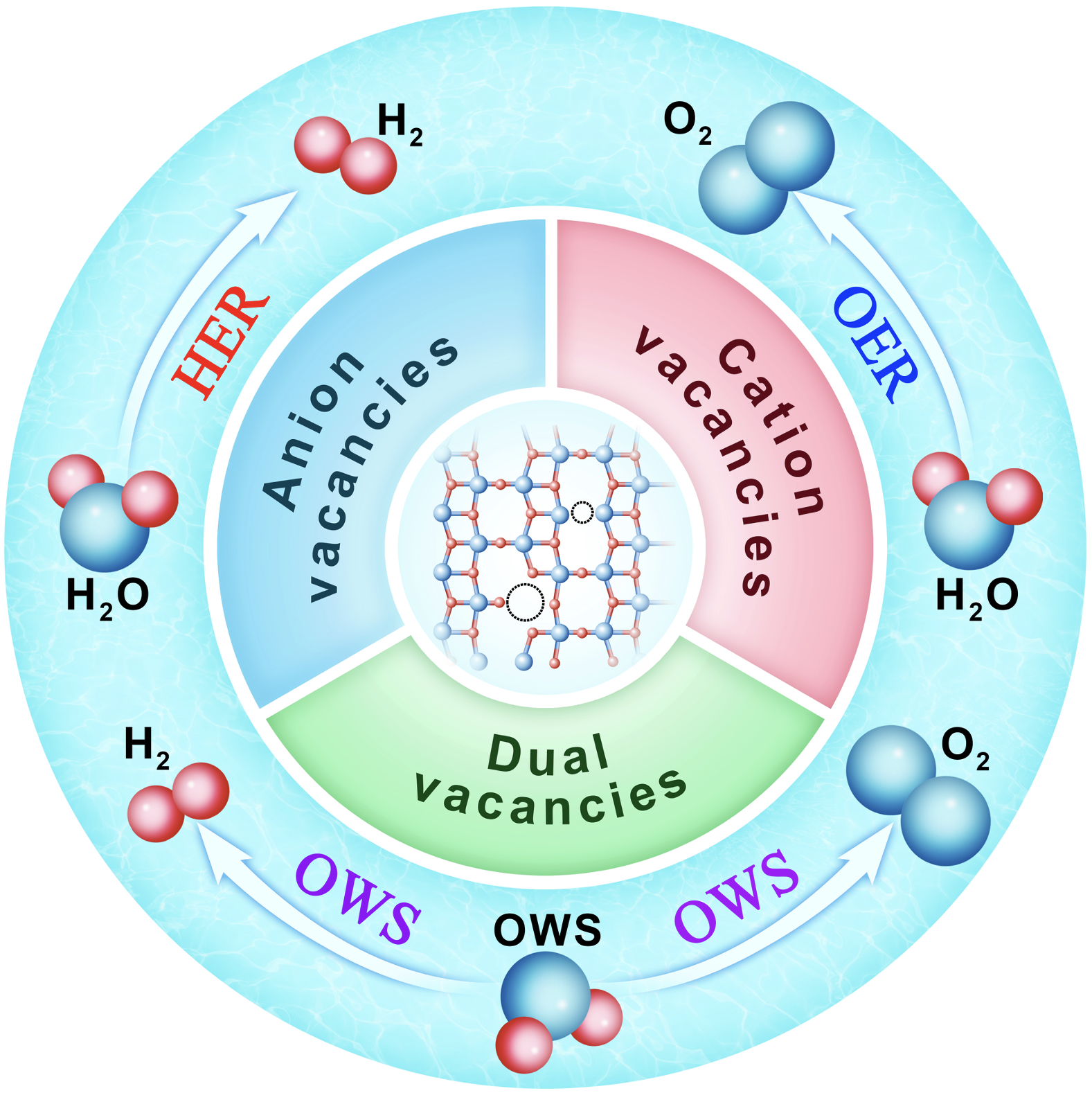
With the increasing demand for sustainable energy solutions, electrocatalysis has become an essential technology for energy conversion and storage. Despite significant advancements, traditional electrocatalysts still face persistent challenges in enhancing activity and improving stability. Recent studies have shown that vacancy engineering—modifying the atomic structure of materials through the introduction of vacancies—can significantly enhance catalytic efficiency and durability. As such, this approach provides a promising pathway to advance electrocatalysis. This review first explains the mechanisms of the hydrogen evolution reaction (HER) and oxygen evolution reaction (OER) and then provides a comprehensive overview of the application synthesis and characterization of various vacancies strategies, including anionic vacancies, cationic vacancy, and combined anionic–cationic vacancies. The review deeply analyzes the role of vacancies in the electrocatalysts for HER, OER, and overall water splitting. Moreover, the advanced characterization techniques for vacancies are introduced to demonstrate the effects of vacancies from the atomic level. Finally, the review addresses the current challenges and limitations associated with vacancy engineering and proposes potential directions for future research.

Cite this article

Qing Zhang , Yuhai Dou , Cong Liu , Haining Fan , Mingjin Cui , Porun Liu , Hua Kun Liu , Shi Xue Dou , Ding Yuan . Vacancy Engineering Strategies for Water Splitting Electrocatalysts[J]. Electrochemical Energy Reviews, 2025 , 8(4) : 36 . DOI: 10.1007/s41918-025-00262-z

Options
Outlines

/