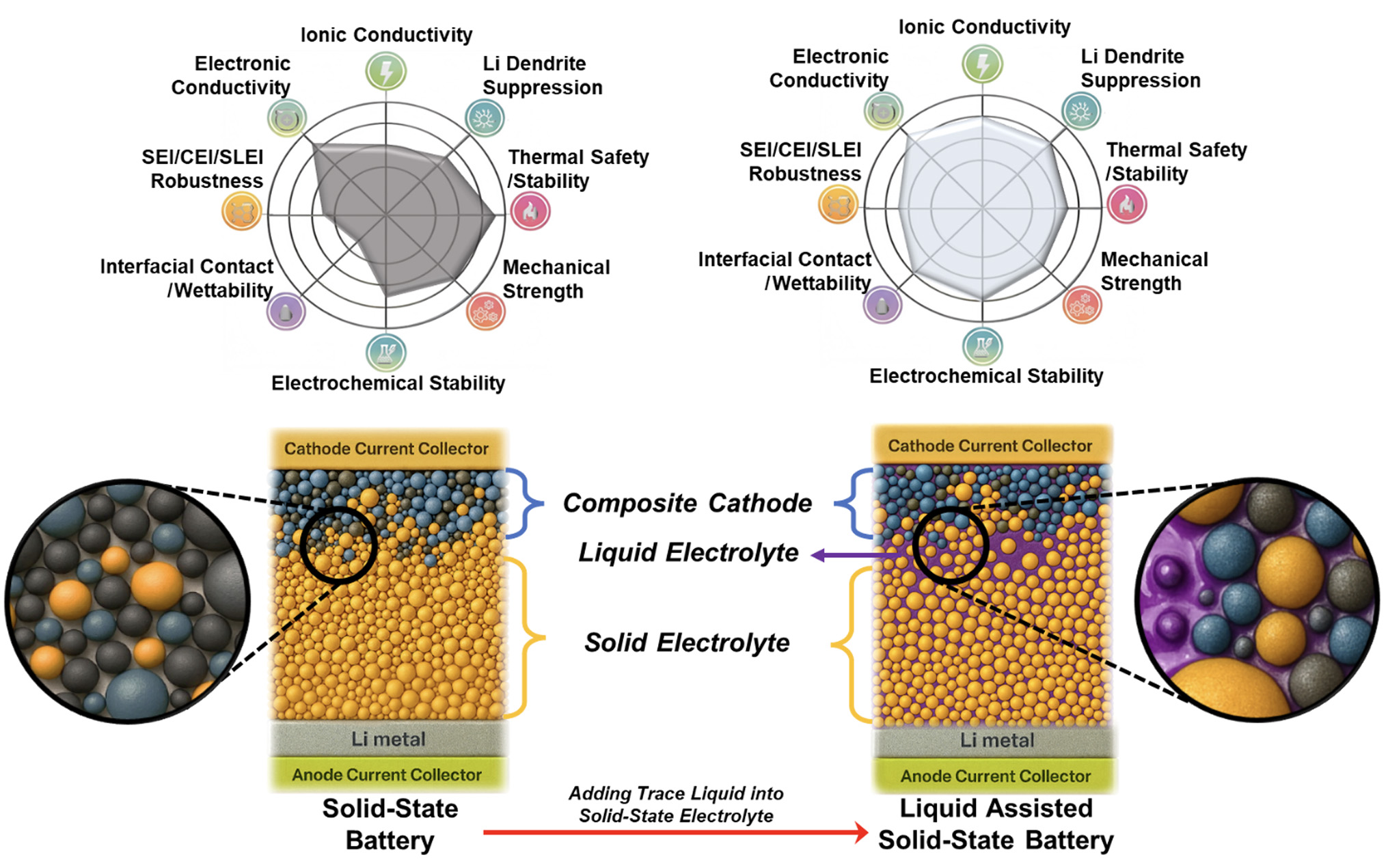
Solid-state lithium batteries (SSLBs) are approaching practical deployment, following breakthroughs in overcoming remaining interfacial transport barriers. A pragmatic solution has emerged: the introduction of a small quantity of liquid electrolyte to wet rough interfaces, restore contact, and open fast-ion pathways. Although such liquid additives are now widely adopted across laboratories, the evidence base remains scattered and terminology inconsistent. This review consolidates recent progress and distills design principles for integrating a fraction of liquid into nominally solid-state batteries. We classify chemistries as conventional salt-in-solvent electrolytes, ionic liquids, and gel polymer electrolytes, and map their implementation at solid electrolyte/electrode interfaces. Mechanisms are discussed through which fractional liquid additives reduce interfacial impedance, suppress void growth, and tune interphase chemistry. Improvements in electrochemical performance, including cycling stability and rate capability, are compared alongside trade-offs such as safety risks (flammability, volatility, parasitic reactions, and lithium penetration). Protocols are outlined to quantify the minimum effective additive content while retaining the intrinsic advantages of SSLBs (high-energy density and superior safety). Finally, future research directions are proposed to guide translation from bench to market, including operando mapping of liquid distribution, durability under practical areal loadings and stack pressures, and scalable delivery methods.
Xingwen Yu
,
Zizhou He
,
Zhangsen Chen
,
Serdar Yildirim
,
Kayla Smith
,
James Wu
,
Arumugam Manthiram
,
Siyi Cao
,
Yudong Wang
,
Nengneng Xu
,
S. Pamir Alpay
,
Radenka Maric
,
Shuhui Sun
,
Xiao Dong Zhou
. Solid-State Lithium Batteries with Liquid Additives: A Critical Review of Progress and Challenges[J]. Electrochemical Energy Reviews, 2026
, 9(1)
: 3
.
DOI: 10.1007/s41918-025-00273-w