Salt-Assisted Synthesis of 2D Materials for Electrochemical Applications

  • Kang Chen ,
  • Liang Huang ,
  • Kaifu Huo
Expand
  • 1. School of Optical and Electronic Information, Union Hospital, Tongji Medical College, Wuhan National Laboratory for Optoelectronics, Huazhong University of Science and Technology, Wuhan 430074, Hubei, China;
    2. Shenzhen Huazhong University of Science and Technology Research Institute, Shenzhen 518038, Guangdong, China

Received date: 2025-04-26

  Revised date: 2025-10-11

  Accepted date: 2025-12-07

  Online published: 2026-02-13

Supported by

This work is supported by the support of the National Key Research and Development Program of China (2022YFA1203503), the National Natural Science Foundation of China (52272111, 52572225, U2004210), and Shenzhen Science Technology Program (202308073003128).
Abstract

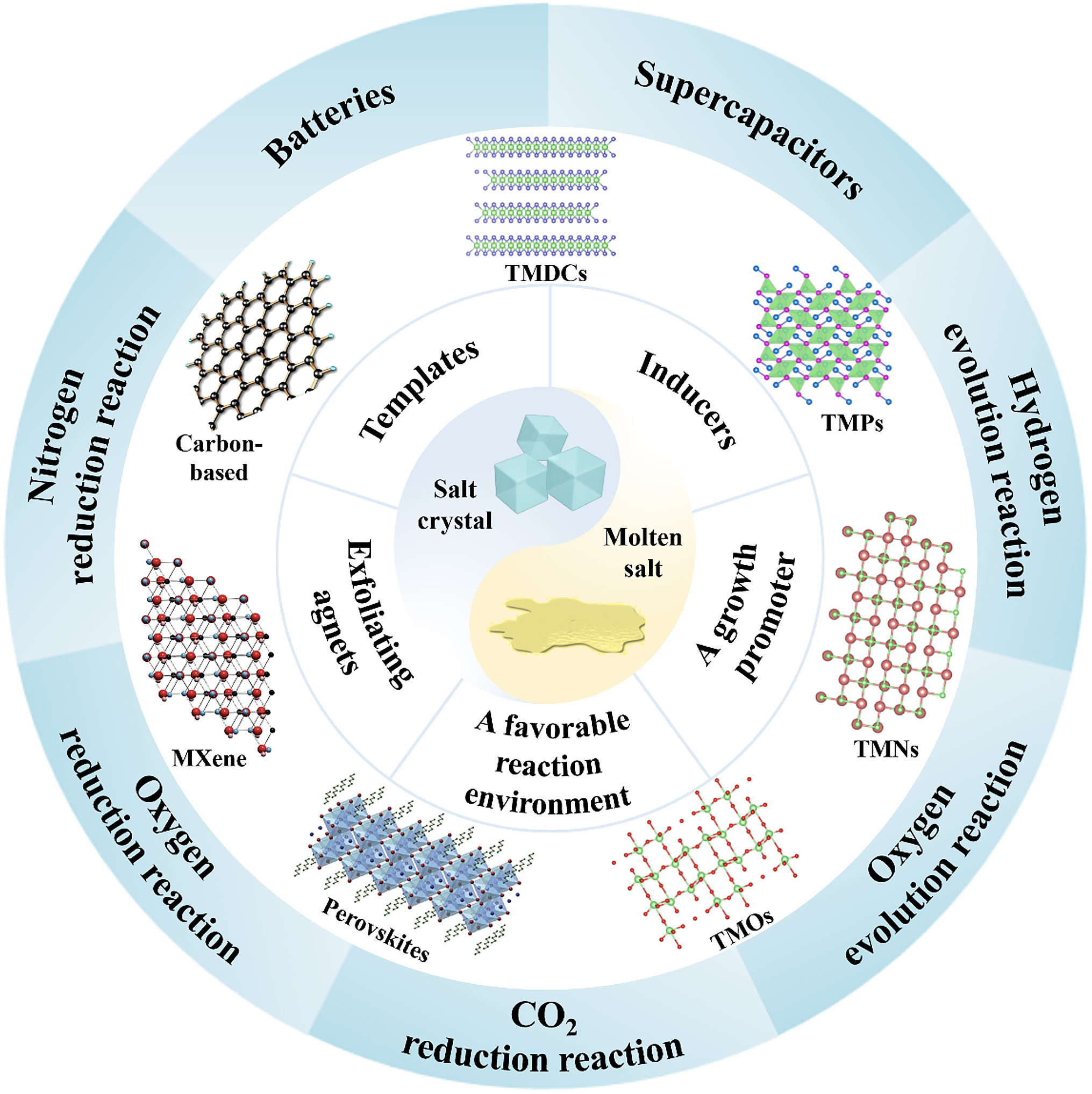
Two-dimensional (2D) materials have emerged as promising candidates for electrochemical energy storage and conversion applications, owing to their unique structural features and exceptional physicochemical properties. However, the large-scale practical deployment of these materials remains highly dependent on the development of efficient and scalable fabrication techniques. Notably, salt-assisted synthesis strategies have gained significant attention as a versatile approach, enabling precise structural modulation and performance optimization of 2D materials while maintaining cost efficiency and procedural simplicity. This review systematically summarizes recent advances in the salt-assisted synthesis of 2D materials and highlights their emerging roles in electrochemical applications. The influences of salt media on crystal nucleation, growth behavior, and surface properties for synthesizing 2D materials are discussed firstly in this review. Furthermore, representative 2D materials synthesized via this strategy are categorized and evaluated for applications in metal-ion batteries, supercapacitors, and electrocatalysis. Finally, the prevailing challenges and future research directions are critically assessed, targeting scalable production, mechanistic understanding, and multifunctional integration of salt-assisted synthesis for 2D materials. This comprehensive overview aims to provide fundamental insights and practical guidelines for the design of high-performance 2D electrochemical materials.

Cite this article

Kang Chen , Liang Huang , Kaifu Huo . Salt-Assisted Synthesis of 2D Materials for Electrochemical Applications[J]. Electrochemical Energy Reviews, 2026 , 9(1) : 5 . DOI: 10.1007/s41918-025-00276-7

Options
Outlines

/