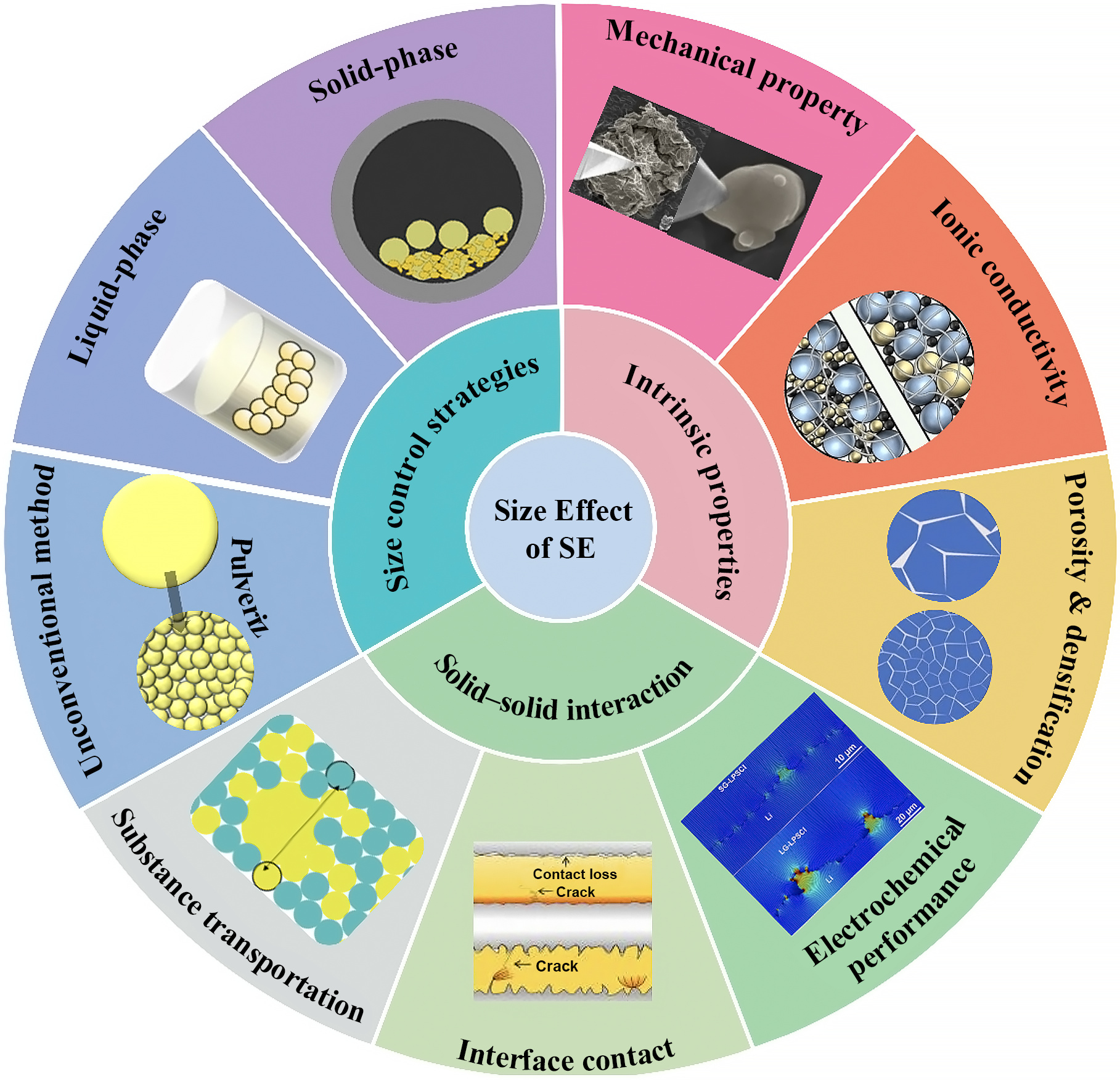
All-solid-state batteries (ASSBs) represent a promising strategy to simultaneously increase the safety and energy density of conventional lithium-ion batteries (LIBs), particularly when paired with high-capacity anodes such as lithium metal. However, the further development of ASSBs has been constrained by solid-solid contact failure, interfacial degradation, and short-circuiting caused by lithium dendrites that penetrate the solid electrolyte (SE). Despite the significant progress in material development, the impact of changes in the intrinsic structures of materials (e.g., the particle size effect of SEs) remains insufficiently understood. In this review, synthesis strategies for regulating SE particle size and the intrinsic physical and chemical properties of particles after size reduction are comprehensively summarized. Furthermore, the effects of particle size on ASSBs are critically analyzed. Key findings reveal that reduced particle size enhances mechanical properties and increases active contact areas but may exacerbate interfacial side reactions and agglomeration issues. Conversely, larger particles exhibit higher ionic conductivity but impede the densification of SEs. Moreover, the heterogeneous solid-solid interfaces and three-dimensional percolation networks arising from multiscale SE particle contacts collectively govern ASSB performance. By integrating advances in size-controlled synthesis, characterization, and modeling, this review highlights current knowledge gaps and presents strategies to better align particle engineering with interface design. This framework aims to advance high-performance ASSBs via particle size control, bridging fundamental insights with practical battery design.This review systematically summarizes strategies for modulating electrolyte particlesize, size-dependent changes in intrinsic physicochemical properties, and the sizeeffects that influence the electrochemical performance of all-solid-state batteries
Tianyu Lei
,
Linfeng Peng
,
Chaochao Wei
,
Shijie Cheng
,
Jia Xie
. Review of Particle Size Effects of Solid Electrolytes in All-Solid-State Batteries[J]. Electrochemical Energy Reviews, 2026
, 9(3)
: 16
-16
.
DOI: 10.1007/s41918-026-00288-x