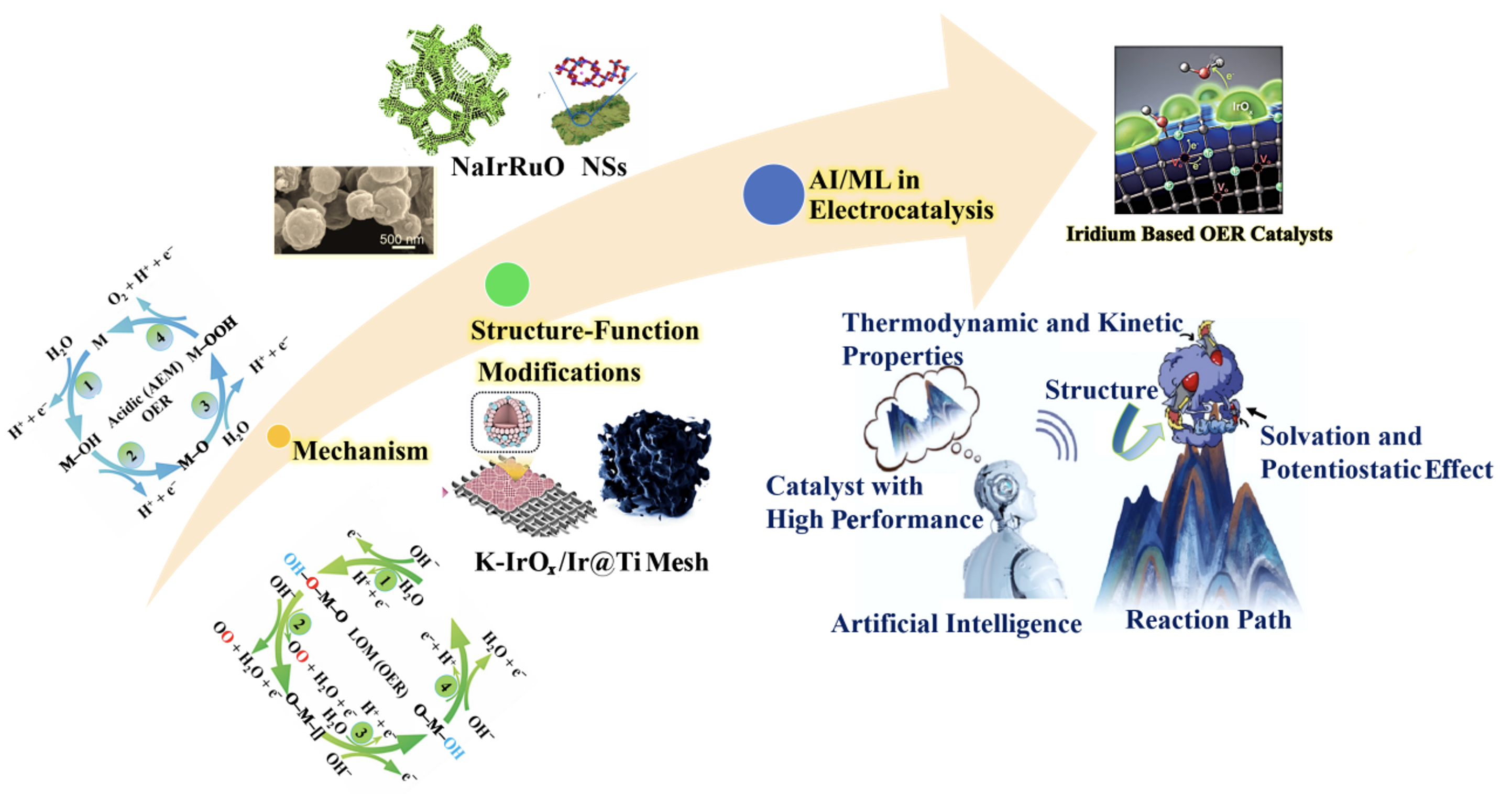
Iridium-based catalysts remain the benchmark catalysts for the oxygen evolution reaction (OER) in acidic media, a critical half-reaction in proton exchange membrane water electrolyzers (PEMWEs), yet their large-scale deployment is limited by high cost, restricted availability, and progressive degradation under severe operating conditions. This review delivers a comprehensive evaluation of advances in catalytic mechanistic understanding, structural design, and practical implementation of Ir-based electrocatalysts. In acidic electrolytes, the OER has been primarily interpreted through the adsorbate evolution mechanism (AEM) and the lattice oxygen-mediated mechanism (LOM). However, growing evidence highlights the significance of complementary pathways, including oxygen vacancy site-mediated processes, oxygen path (direct O–O radical coupling), acid–base and direct coupling pathways, coupled oxygen evolution, multi-hole (local high concentration of OH) oxygen evolution, sequential oxygen kinetics, and electrochemical-thermal mechanisms. These additional models provide more detailed insights into reaction intermediates, active-site dynamics and kinetic bottlenecks, thereby further clarifying the activity-stability trade-off. Key degradation routes including lattice dissolution, surface reconstruction, and support corrosion are reviewed, together with the structure–function relationships derived from morphology regulation, alloying, heteroatom incorporation, phase and lattice engineering, and integration with conductive supports. Representative systems ranging from elemental Ir and IrO2 polymorphs to single-atom catalysts and perovskites are critically assessed with respect to their electronic structure, active-site configuration, and long-term durability. Industrial application aspects are also discussed in detail, encompassing the industrial-level development of PEMWE technology, regional progress toward large-scale implementation, major research organizations and enterprises, potential application domains, and recent developments in industrial devices. In addition, the accelerating role of artificial intelligence and machine learning in catalyst discovery is also discussed. Persisting challenges and research opportunities are further outlined to guide the rational design of robust, scalable, and cost-efficient Ir-based electrocatalysts for next-generation acidic water electrolysis.
Key words:
PEMWE; AEM; LOM; OER; H2; AI; ML
Yuxin Zhang
,
Hongbin Zhao
,
Yu Gao
,
Muhammad Arif Khan
,
Zhonghong Xia
,
Daixin Ye
,
Huidong Qian
,
Jiujun Zhang
. Rational Design and Multi-Scale Engineering of Iridium-Based Catalysts for Acidic Oxygen Evolution: From Atomic-Level Insights to Industrialization[J]. Electrochemical Energy Reviews, 2026
, 9(3)
: 19
-19
.
DOI: 10.1007/s41918-026-00290-3