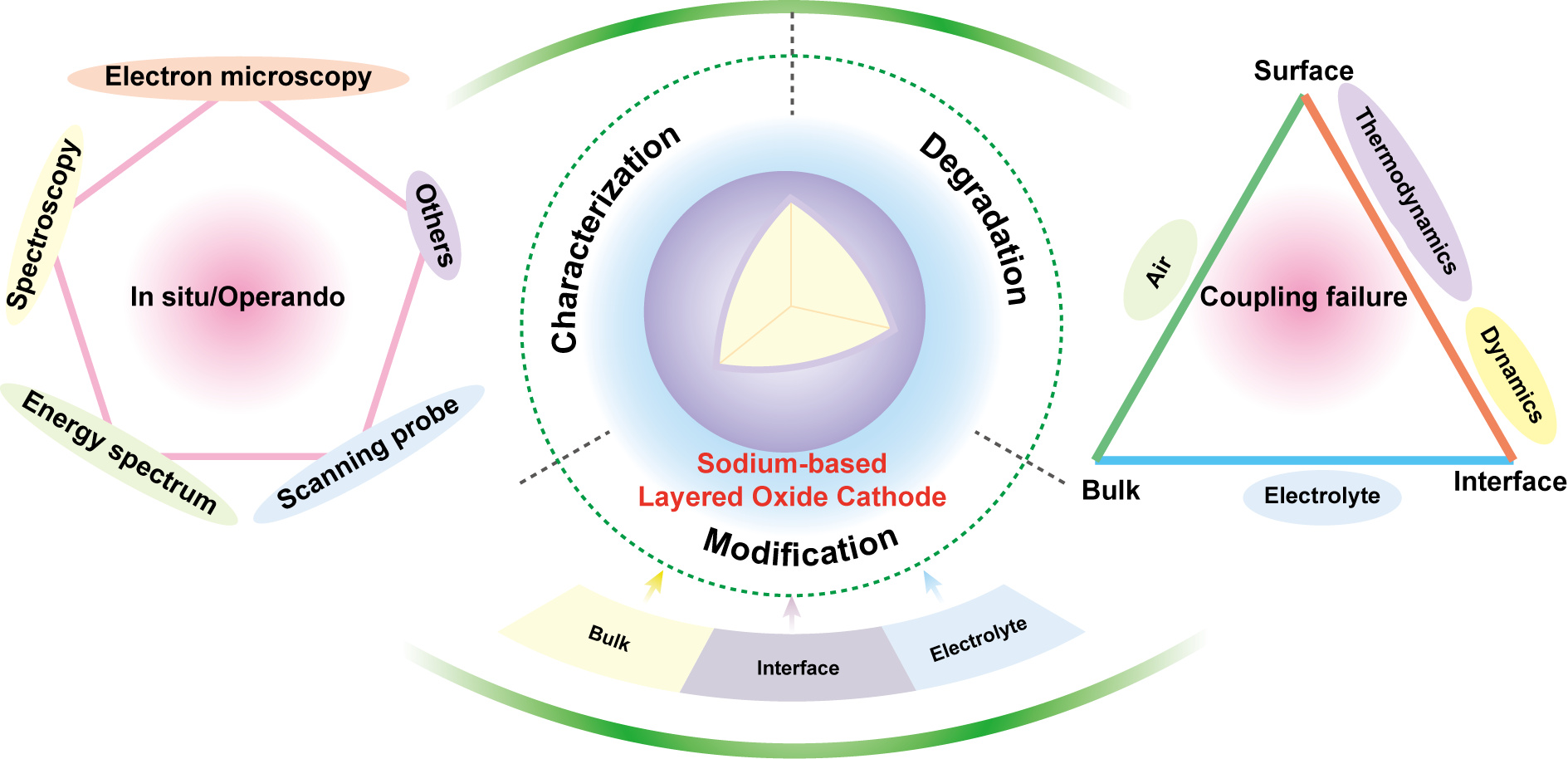
Sodium-ion batteries (SIBs) represent a compelling alternative to lithium-ion batteries (LIBs) for large-scale industrialization, primarily due to their cost-effectiveness, enhanced safety profiles, and superior performance in cold climates. Within the spectrum of cathode materials, sodium-based layered transition-metal oxides (NaxTMO2) stand out for their high energy density and manufacturing scalability. Nevertheless, practical deployment is severely impeded by surface and interfacial instabilities triggered by environmental exposure and electrolyte interactions. This paper offers a comprehensive review of the interfacial instability mechanisms in NaxTMO2, encompassing their origins, evolutionary pathways, mitigation strategies, and cutting-edge characterization techniques. We begin by elucidating the fundamental thermodynamics and kinetics governing surface and interfacial behaviors, demonstrating how the coupling of bulk and interface evolution induces structural degradation and capacity decay. Subsequently, we systematically classify stabilization strategies—including bulk-phase engineering, interfacial architecture design, and electrolyte optimization—evaluating their efficacy in addressing specific failure modes. The critical roles of in situ and operando characterization in decoding interfacial evolution under coupled electrochemical, mechanical, and chemical stresses are also analyzed. Finally, we propose future research directions for interface stabilization, highlighting the imperative to translate fundamental insights into actionable design principles for SIBs and next-generation energy storage systems.
Caixia Chen
,
Peizhao Shan
,
Jun Zhou
,
Chenpeng Xie
,
Yixiao Li
,
Zhongru Zhang
,
Wenhua Zuo
,
Yong Yang
. Interfacial Chemistry of Layered Oxide Cathodes for Sodium-Ion Batteries: A Review[J]. Electrochemical Energy Reviews, 2026
, 9(3)
: 22
-22
.
DOI: 10.1007/s41918-026-00295-y