Automotive Li-Ion Batteries: Current Status and Future Perspectives

Expand
  • 1 Department of Chemical Engineering, Waterloo Institute for Nanotechnology, Waterloo Institute for Sustainable Energy, University of Waterloo, 200 University Avenue West, Waterloo, ON N2L 3G1, Canada;
    2 Chemical Sciences and Engineering Division, Argonne National Laboratory, Argonne, IL 60439, USA

Received date: 2018-06-26

  Revised date: 2018-09-09

  Online published: 2019-04-03

Supported by

The authors greatly appreciate the fnancial support from the Natural Sciences and Engineering Research Council of Canada (NSERC), the University of Waterloo and the Waterloo Institute of Nanotechnology. J. Lu gratefully acknowledges support from the U. S. Department of Energy (DOE), Ofce of Energy Efciency and Renewable Energy, Vehicle Technologies Ofce. Argonne National Laboratory is operated for DOE Ofce of Science by UChicago Argonne, LLC, under contract number DE-AC02-06CH11357.
Abstract

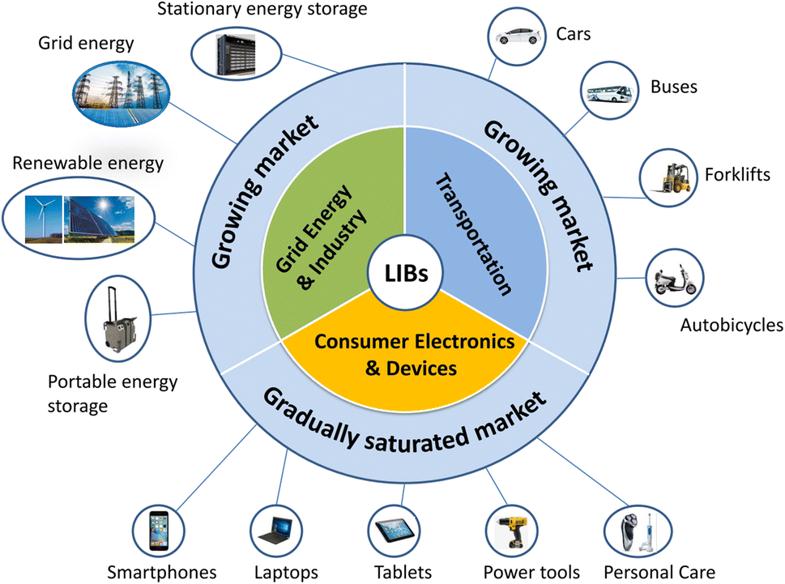
Lithium-ion batteries (LIBs) are currently the most suitable energy storage device for powering electric vehicles (EVs) owing to their attractive properties including high energy efciency, lack of memory efect, long cycle life, high energy density and high power density. These advantages allow them to be smaller and lighter than other conventional rechargeable batteries such as lead-acid batteries, nickel-cadmium batteries (Ni-Cd) and nickel-metal hydride batteries (Ni-MH). Modern EVs, however, still sufer from performance barriers (range, charging rate, lifetime, etc.) and technological barriers (high cost, safety, reliability, etc.), limiting their widespread adoption. Given these facts, this review sets the extensive market penetration of LIB-powered EVs as an ultimate objective and then discusses recent advances and challenges of electric automobiles, mainly focusing on critical element resources, present and future EV markets, and the cost and performance of LIBs. Finally, novel battery chemistries and technologies including high-energy electrode materials and all-solid-state batteries are also evaluated for their potential capabilities in next-generation long-range EVs.

Full-text:https://link.springer.com/article/10.1007/s41918-018-0022-z

Cite this article

Yuanli Ding, Zachary P. Cano, Aiping Yu, Jun Lu, Zhongwei Chen . Automotive Li-Ion Batteries: Current Status and Future Perspectives[J]. Electrochemical Energy Reviews, 2019 , 2(1) : 1 -28 . DOI: 10.1007/s41918-018-0022-z

Options
Outlines

/