Lead-Carbon Batteries toward Future Energy Storage: From Mechanism and Materials to Applications
Received date: 2020-12-17
Revised date: 2021-07-02
Online published: 2022-10-25
Supported by
The authors acknowledge the financial support from the National Natural Science Foundation of China (Nos. 22108044, 21573093, 21975101), the Science and Technology Innovation Team Project of Jilin University (No. 2017TD-31), the National Natural Science Foundation of China (No. 21706038), the National Natural Science Foundation of China (No. 22038004), the Natural Science Foundation for Guangdong Province (No. 2019B151502038), the National Key Research and Development Plan (No. 2018YFB1501503), the Research and Development Program in Key Fields of Guangdong Province (2020B1111380002), and the financial support from the Guangdong Provincial Key Laboratory of Plant Resources Biorefinery (2021GDKLPRB07). Wenli Zhang acknowledges the start-up funding of Guangdong University of Technology.
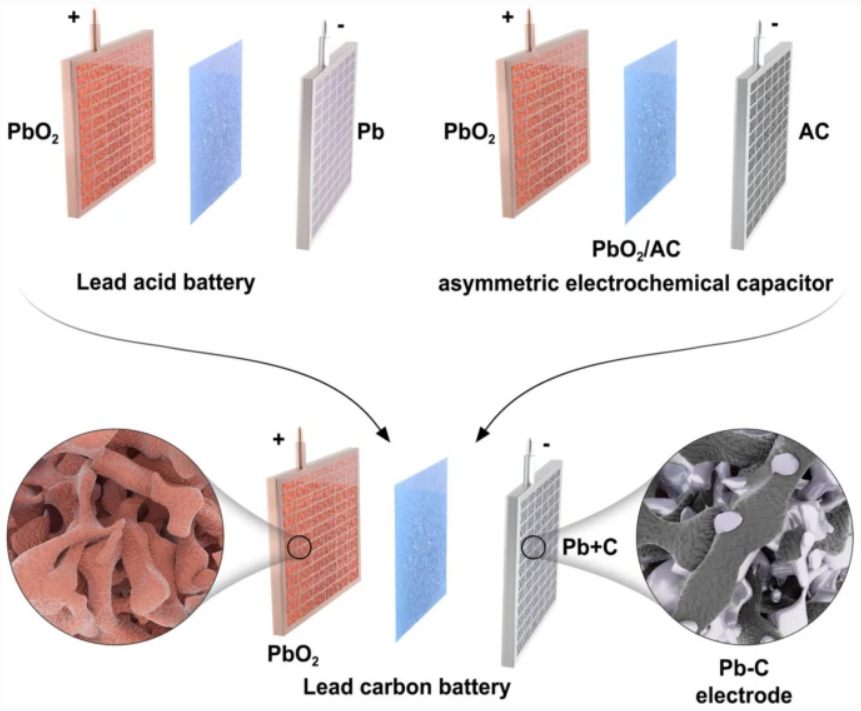
Key words: Lead acid battery; Lead-carbon battery; Partial state of charge; PbO2; Pb
Jian Yin, Haibo Lin, Jun Shi, Zheqi Lin, Jinpeng Bao, Yue Wang, Xuliang Lin, Yanlin Qin, Xueqing Qiu, Wenli Zhang . Lead-Carbon Batteries toward Future Energy Storage: From Mechanism and Materials to Applications[J]. Electrochemical Energy Reviews, 2022 , 5(3) : 2 . DOI: 10.1007/s41918-022-00134-w
/
| 〈 |
|
〉 |