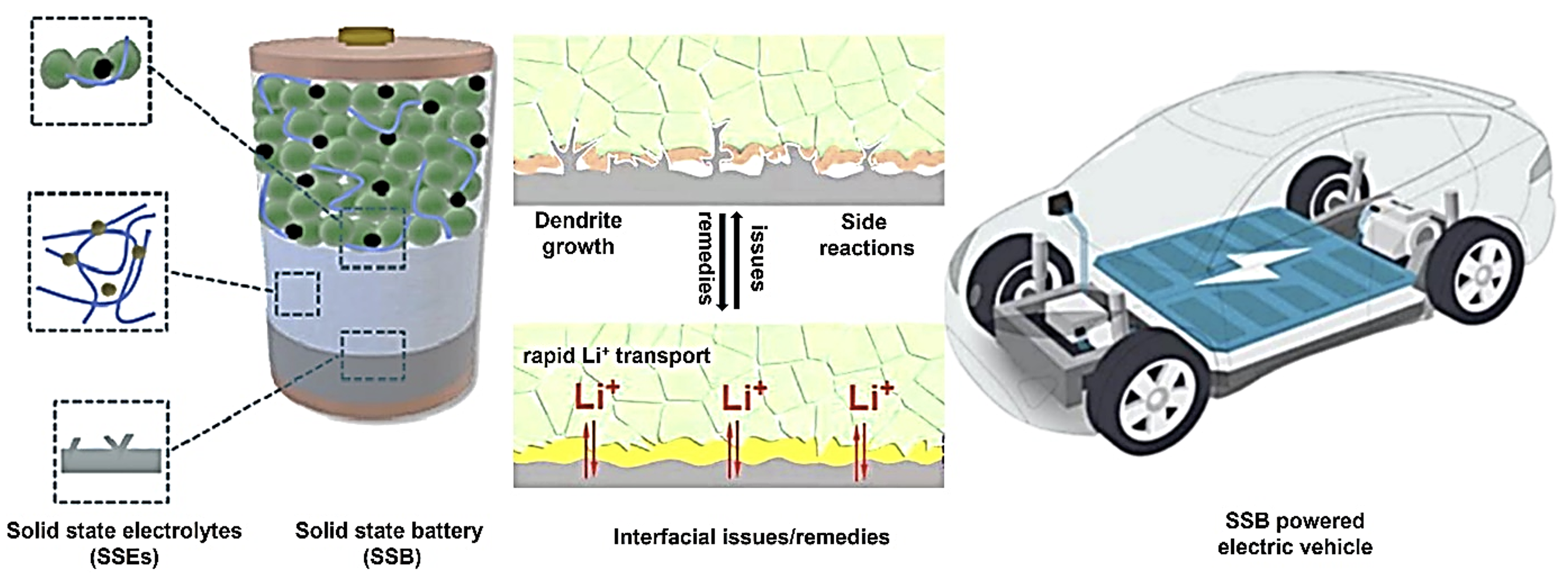
Solid-state batteries (SSBs) have emerged as a promising alternative technology for advancing global electrification efforts. The SSBs offer significant advantages over conventional electrolyte-based batteries, including enhanced safety, increased energy density, and improved performance. Their non-flammability, enhanced thermal and mechanical stability, and lower self-discharge rates make them particularly promising for future energy solutions. However, their prevalent implementation in large-scale industries is inhibited by inadequate ionic conductivity and the interfacial challenges associated with solid-state electrolytes (SSEs). These challenges include suboptimal solid–solid contact, grain boundary limitations, poor wettability, and unfavorable phenomena such as dendrite growth, interface voids, interdiffusion layer formation, and lattice mismatch. This comprehensive review meticulously examines recent developments and prospects in SSEs, categorizing them into halide, sulfide, oxide, hydride, and polymer types. It then analyzes the challenges and interfacial limitations of SSBs, including dendrite growth, voids, cracks, contact issues, lattice mismatch, and interdiffusion. In addition, potential solutions for enhancing interfacial adherence between electrodes and SSEs are outlined. Furthermore, recent trends in the SSB industry, including successfully commercialized products, are highlighted. Finally, this review explores the future potential of SSEs in advanced SSBs, projecting their significant industrial impact.
Seul-Yi Lee
,
Jishu Rawal
,
Jieun Lee
,
Jagadis Gautam
,
Seok Kim
,
Gui-Liang Xu
,
Khalil Amine
,
Soo-Jin Park
. Solid-State Electrolytes and Their Interfacial Properties: Implications for Solid-State Lithium Batteries[J]. Electrochemical Energy Reviews, 2025
, 8(2)
: 9
.
DOI: 10.1007/s41918-025-00242-3